

What if anxiety on the course could become a cue to practice faithfulness, not proof that you’ve failed? Fear of a missed shot can crowd your thoughts and unsettle your decisions, while pressure to score can make a round feel like a measure of your worth. A faith based golf mental game offers another way: meet nerves with a steady routine, make thoughtful course decisions, and remember that your value isn’t on the scorecard.
If you’re wondering how to handle golf anxiety in a way that fits your Christian faith, this article offers practical steps for preparing, committing to each shot, and responding constructively after mistakes. Golf can also be a calling from the Lord and an opportunity to make disciples among golfers and those the Lord is calling into a relationship with Him. The aim is to become the best golfer you can, working with the Lord to improve and letting the gifts of the Spirit show in how you play and relate to others.
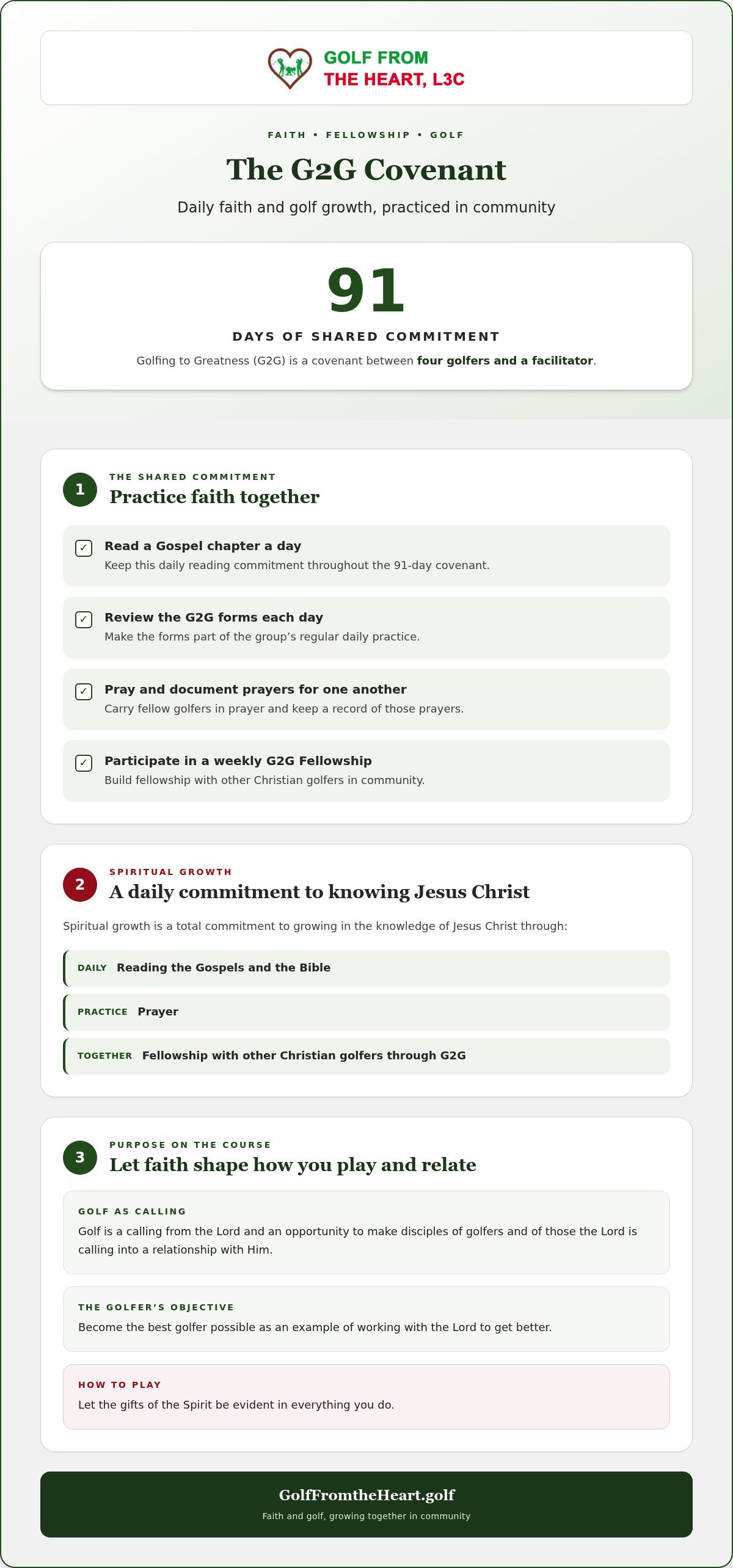
Spiritual growth calls for a daily commitment to knowing Jesus Christ through reading the Gospels and the Bible, prayer, and fellowship with other Christian golfers. Golfing to Greatness (G2G) puts that commitment into a covenant between four golfers and a facilitator: read one Gospel chapter a day for 91 days, review the G2G forms each day, participate in a weekly G2G Fellowship, and document prayers for one another. These practices connect golf development with faith, fellowship, and service.
Key Takeaways
- Use a familiar pre-shot routine to bring your attention back to the shot in front of you when nerves rise.
- A faith based golf mental game pairs process-focused decisions with prayer and perspective, without treating either as a promise of a particular score.
- After a mistake, pause, choose a constructive next step, and let the moment inform your growth rather than define your worth.
- Set a process goal before play, then focus on decisions you can make one shot at a time instead of predicting your score.
- Golf instruction and Christian fellowship can support skill development, spiritual growth, and the way you serve others on the course.
How Golf Anxiety Shows Up, and Why It Does Not Define Your Game
Nerves before a shot, tension that lingers through a round, or frustration after a costly mistake can feel unsettling. These moments don’t mean you’re failing. Golf anxiety is pressure or worry that can interfere with attention and decision-making. You might second-guess a club choice or rush a swing because you’re focused on what could go wrong. Occasional nerves are part of some golfers’ experience; they aren’t, by themselves, a diagnosis.
Golf’s pauses can leave room for thoughts to build between shots. Worry about a hazard, a score, or an upcoming match may pull your focus from the information in front of you. Sport psychology considers how psychological factors relate to athletic performance and well-being. On the course, noticing a pressure response is a useful first step toward choosing what to focus on next. Anxiety isn’t proof of weak faith, poor character, or lack of ability.
Notice the moments and thoughts that trigger pressure
Pressure may appear on the first tee, over a difficult shot, after an early bogey, or while playing with people whose opinions matter to you. The situation can prompt outcome-focused thoughts: “I can’t miss this fairway,” or “If I make another mistake, the round is ruined.” Those thoughts direct attention toward possible consequences instead of the lie, target, and options available for the present shot.
Observe these patterns without judging yourself. After a round, consider when tension showed up, what you were thinking, and how it influenced your choices. For example, did concern about a water hazard lead you to change your plan at the last moment? Treat the answer as useful information, not a reason to criticize yourself. Recognizing a familiar trigger helps you prepare a response that suits your game, and exploring mindset resources like The Magnetic Recalibration can provide useful insight into shifting automatic subconscious reactions when pressure takes over.
Separate your score from your worth
A score describes how you played on a particular day. It can point to skills that need practice, but it can’t define your identity or measure your worth as a person. Review a poor decision honestly without turning it into a judgment about yourself. Ask what you might learn, take responsibility for what was within your control, and give yourself room to improve over time.
Your score measures a round, not your worth as a person.
Grace and accountability can sit side by side. You don’t have to dismiss a disappointing result to avoid shame, and you don’t have to condemn yourself to take improvement seriously. A grounded perspective lets you acknowledge what happened, identify one useful takeaway, and move forward with self-respect. Nerves may still arise, but they don’t have to define your ability to learn or how you treat yourself and others.
What Happens in a Pressure Moment: Attention, Routine, and the Next Shot
In a pressure moment, your mind can race ahead of your body. You may stand over a shot while imagining the score, the trouble beyond the target, or what others will think if you miss. That mental detour can make it harder to attend to the information you need now: the lie, the target, and the swing you’ve prepared to make. You don’t have to force every thought away. Notice when attention has drifted and gently bring it back.
A pre-shot routine gives you a familiar sequence to return to. It doesn’t remove every nerve or promise a particular result. It offers structure for making a decision and preparing to act, even if you still feel pressure. In a faith based golf mental game, prayer can be part of that preparation and help you keep perspective, but it isn’t a way to guarantee a good shot or a lower score.
Use a simple pre-shot sequence to return to the present
Choose a sequence that fits your game and repeat it in the same order. For example, assess the lie, select a target, make a clear club and shot decision, then step into your familiar setup. Before you swing, use one short process cue such as “smooth tempo” or “finish balanced.” Keep the cue about an action you can take, not the score you hope to post. Practice the sequence on the range and during relaxed rounds so it feels familiar when pressure rises.
Once you’ve made a sound decision, shift from analysis to execution. Rechecking the target or changing plans repeatedly can feed doubt rather than clarify the shot. Your routine sets a boundary: think through the choice, then commit to the swing you intend to make. A useful pre-shot routine is a practiced sequence that helps you choose, prepare, and commit to the shot in front of you.
Respond to a mistake without carrying it to the next hole
A poor shot may sting. You might feel frustrated, and you don’t need to pretend otherwise. Acknowledge what happened and decide whether there’s one useful lesson, such as choosing a safer target next time or giving yourself more time to settle. Then turn your attention to the next task: walking to the ball, reading the lie, or planning the next shot. That shift won’t erase the feeling, but it can keep one mistake from making decisions for the rest of the round.
Patience and self-control are part of Christian character, not signs that you must play perfectly or stay calm every second. Take responsibility for your choices while meeting yourself with grace, then extend that same respect to your playing partners. If you want practical support developing skills and responses under pressure, faith-integrated golf instruction connects practice on the course with growth in character.
Faith-Based Golf Mental Game: Helpful Practices and Misconceptions
Faith and golf preparation can support one another without turning spiritual practice into a formula for controlling results. Prayer may help you bring concerns honestly before God and consider how you want to meet the moment, but it can’t guarantee a fairway, a made putt, or a particular score. A faith based golf mental game leaves room for practical effort and spiritual perspective without confusing either with control over every outcome.
Another misconception is that strong faith means you’ll never feel nervous or disappointed. Emotions can surface even as you seek to live faithfully. Rather than treating them as a spiritual failure, notice what’s happening and consider how you want to respond. Faith can inform your choices without demanding that you feel a certain way before you play with purpose.
| Process-focused habits | Outcome fixation |
|---|---|
| Choose a shot plan based on the situation in front of you. | Keep calculating the score you think you need. |
| Review a decision to find a practical lesson. | Let one mistake convince you that the round is beyond saving. |
| Use prayer to seek perspective and intention. | Treat prayer as a way to secure a specific result. |
Choose faith practices that support, not replace, golf preparation
Prayer or a brief reflection can accompany technical practice and course planning, rather than stand in for them. Before playing a challenging hole, you might pause to reflect on patience, then assess the lie and decide how to approach the shot. At practice, work on a specific skill while noticing how you respond when an attempt doesn’t go as planned. Keep spiritual practices sincere and personal, not a performance formula.
After a round, reflect briefly on effort, choices, gratitude, and learning. You might recognize a thoughtful decision, appreciate a playing partner’s encouragement, or note a moment when frustration influenced your judgment. The purpose isn’t to judge your spiritual life by how well you played. It’s to make space for honest reflection that can shape your next practice and the way you meet future challenges.
Treat improvement as faithful work, not a guarantee
Improvement takes patience, attentive practice, and a willingness to learn from both strong and difficult rounds. Set goals around what you can work on, such as improving a skill or making decisions with care, while accepting that results remain uncertain. That balance lets you pursue excellence without expecting every effort to produce an immediate reward.
Let your values guide how you compete and relate to others, including when you feel disappointed or under pressure. Your conduct can show care, honesty, and respect even on a day when your game is uneven. Faith doesn’t require perfect composure or perfect play; it can shape the next choice you make, on the course and beyond it.
A Practical Plan for Handling Golf Anxiety Before, During, and After a Round
A plan can’t promise a calm round, but it can give you helpful steps to return to when pressure rises. Adapt the process to your game and beliefs. Keep it simple enough to remember, and focus on choices you can make rather than outcomes you can’t control.
Before the round: prepare your attention and intention
Before you play, choose one process goal, such as committing to your target or following your usual routine. If it feels sincere to you, include a brief prayer or Scripture reflection to set an intention for the day. You might also decide how you’ll respond if the round doesn’t go as hoped, so a disappointing hole doesn’t dictate what comes next.
- Set a controllable focus. Name one action you can practice today, such as making a clear target choice or keeping to your pre-shot sequence. Let that be your measure of attention, not a prediction about your final score.
- Prepare with purpose. Use your familiar warm-up and review the course plan you’ve made. If you pray or reflect on Scripture, do so in a way that feels personal, asking for wisdom, patience, or gratitude rather than treating faith as a formula for a particular result.
- Choose a response in advance. Decide on a simple next step for a difficult moment: acknowledge the frustration, take a comfortable breath, and return to the next decision. Planning for imperfection can help you respond with care instead of self-blame.
- Reset during play. When you notice tension or an unhelpful thought, pause. Breathe comfortably, identify the next task, and proceed. That task could be assessing the lie, selecting a target, or walking to your ball. You don’t need to wait until every anxious feeling has gone to make a thoughtful choice.
- Review after the round. Consider your effort and decisions honestly, then name one practical golf lesson and one thing you’re grateful for. Add a character or faith reflection: perhaps you showed patience with a playing partner, or you want to respond more graciously next time. This turns review into learning rather than a replay of every mistake.
During and after the round: reset, reflect, and grow
Keep your review specific and balanced. “I’ll choose a safer target from that lie” gives you something to practice; “I always ruin the round” turns one moment into a verdict. If anxiety repeatedly disrupts your enjoyment or daily well-being, speak with someone you trust, such as a supportive Christian golfer, instructor, pastor, or qualified mental health professional.
A faith based golf mental game grows through steady practice, honest reflection, and room to develop both skill and character. Explore faith-integrated golf lessons for practical support as you develop your game and your response to pressure.
Build a Faith-Based Golf Mental Game Through Instruction and Fellowship
Golf instruction gives you a practical setting to examine how pressure affects your decisions and practice responses that fit your game. An evaluation or lesson can help identify skills to develop, from course choices to parts of your technique you want to strengthen. With clear feedback, you can turn a difficult moment into a useful question: what can I understand, practice, or approach differently next time?
Christian fellowship brings encouragement and shared perspective to that work. Golfing to Greatness (G2G) provides a community where Christian golfers can grow together. Fellowship doesn’t replace individual practice or instruction; it complements them by giving golfers space to encourage one another, reflect on challenges, and build relationships around shared faith. You can keep working on your game while learning from others’ experiences and perspectives.
What the Golfing to Greatness covenant involves
G2G is a covenant between four golfers and a facilitator, committed to reading a Gospel chapter a day for 91 days, reviewing the G2G forms each day, participating in a G2G Fellowship each week, and documenting prayers for one another. This shared framework supports commitment, connection, regular reflection, and mutual encouragement. It gives golfers space to bring questions from the course into fellowship and consider how to respond with patience and integrity.
That community experience sits alongside the work you do on your own. You might use a lesson to identify a skill to practice, then draw on fellowship for encouragement as you keep learning. Support is not a substitute for putting in the work; it connects the work to relationships and values beyond the scorecard.
Find support for both golf development and spiritual growth
Golf evaluations and individual or group lessons offer opportunities to focus on particular skills and areas for development. Christian fellowship helps you stay connected to others as you learn, celebrate progress, and work through setbacks. Together, instruction and community make space for golf growth and personal reflection without suggesting that either guarantees a certain performance outcome.
GolfFromtheHeart.golf offers local golf instruction and Golfing to Greatness communities in Panama City Beach, along with online community options. Whether you’re looking for practical guidance on your game or a Christian community to share the journey, Explore GolfFromtheHeart.golf to find support for continued growth.
Carry Your Growth Into the Next Round
Let your next round be an opportunity to practice a more patient kind of ambition. Improvement takes attention and persistence, but it doesn’t need to become a demand for immediate proof. A faith based golf mental game can help you hold two commitments together: keep developing your abilities and let your Christian character shape the way you pursue them.
Choose one intention that reaches beyond a score, such as showing encouragement to a playing partner or responding to a challenge with humility. Return to it as the day unfolds. This purpose doesn’t make every shot easy, but it can remind you why you play and how you hope to grow through the game.
As a Christian golfer, view golf as a calling from the Lord and an opportunity to make disciples among golfers and those He is calling into a relationship with Him. Pursue becoming the best golfer possible as an example of working with the Lord to improve, with the gifts of the Spirit evident in all you do. Explore GolfFromtheHeart.golf to take the next step with local instruction or Golfing to Greatness fellowship in Panama City Beach.
Frequently Asked Questions
Is golf anxiety normal, even for an experienced golfer?
Nerves can arise at any skill level, including for golfers who have played for years. A tight feeling on the first tee or worry over a difficult approach doesn’t diagnose a condition or show weak faith. Notice when the pressure appears and return to a familiar process, such as checking the lie before choosing a target. If distress persists or affects life beyond golf, seek appropriate professional support.
Can prayer help with golf anxiety?
Prayer can help a Christian golfer reconnect with faith, perspective, and intention, but it can’t guarantee that nerves will disappear or that a score will improve. You might pray for patience before a round, then prepare by reviewing your plan and using your established routine. A faith based golf mental game allows room for different emotional experiences; feeling anxious isn’t a measure of someone’s relationship with God.
How do I calm down before the first tee?
Give yourself time for your usual preparation rather than rushing straight to the tee. Pick one process goal, such as choosing a clear target, and follow the setup sequence you’ve practiced. A short prayer or reflection can help you set an intention if that feels meaningful to you. Instead of predicting your opening-hole score, focus on the next action you control, such as selecting a club.
What should I do when I get anxious over a short putt?
If you feel rushed, step back and give yourself a moment to reset. Read the line, decide on a pace, and return to the putting routine you normally use. Keep attention on the read and the stroke, rather than imagining the consequences of a miss. A single putt is one moment in a round, not a measure of your ability, identity, or worth.
Why do I get nervous when other people watch me play golf?
Knowing someone is watching can bring their possible opinions to mind, pulling attention away from the shot. Notice that thought without trying to prove it wrong, then look again at your target and begin your routine. You may still feel self-conscious as you play. Other people’s presence doesn’t determine your identity or calling, and you can choose to act with care and commitment even while the feeling is there.
How can I stop one bad golf shot from affecting the rest of my round?
You may not be able to prevent disappointment, but you can choose what to do next. Name what happened, identify one useful lesson if there is one, then shift attention to the next decision. A comfortable breath, brief prayer, or personal cue can mark that transition. The goal isn’t to suppress frustration or guarantee a better next shot; it’s to practice patience and self-control.
Does having golf anxiety mean I lack faith?
No. Feeling nervous or disappointed doesn’t prove that your faith is inadequate. Spiritual growth is a total commitment to knowing Jesus Christ through reading the Gospels and the Bible every day, prayer, and fellowship with other Christian golfers in community with Golfing to Greatness. You can bring difficult emotions honestly into that growth and seek encouragement without comparing your faith to someone else’s. Your feelings on the course don’t define your relationship with God.
When should I seek help for anxiety that affects my golf?
Consider seeking support if anxiety repeatedly interferes with enjoying or participating in golf, or affects your well-being away from the course. A qualified mental-health professional can help address concerns that a golf routine alone may not resolve. You can also talk with someone you trust for encouragement. Asking for help is compatible with faith and personal responsibility, and you can continue developing your golf skills as you seek support.


