

The right putting lesson meets your game where it is, not where you think it should be. If you're looking for putting lessons near me in PCB, start by matching instruction to your skill level and the part of your putting you want to improve. Beginners may need help building a repeatable setup and stroke, while experienced players may want focused guidance on pace, direction, or reading greens.
It’s reasonable to want a local instructor who understands your goals and offers an approach that feels right for you. This guide explains what to consider when looking for putting instruction in Panama City Beach, from lesson focus to your current skill level. A clear goal can make practice more purposeful, whether you’re getting comfortable on the green or refining your stroke. For Christian golfers, working to improve can also nurture patience and humility as part of a life of faith.
Key Takeaways
- Choose putting instruction that matches your current ability and the specific part of your game you want to develop.
- Explore local lesson options by considering location, lesson format, and whether the instruction focuses on putting.
- Use an instructor’s qualifications, experience, and reviews to understand their background and teaching fit.
- Arrive ready to describe your goals and work on a clear next step, so practice can support steady progress on the green.
Finding local golf instructors and lesson options
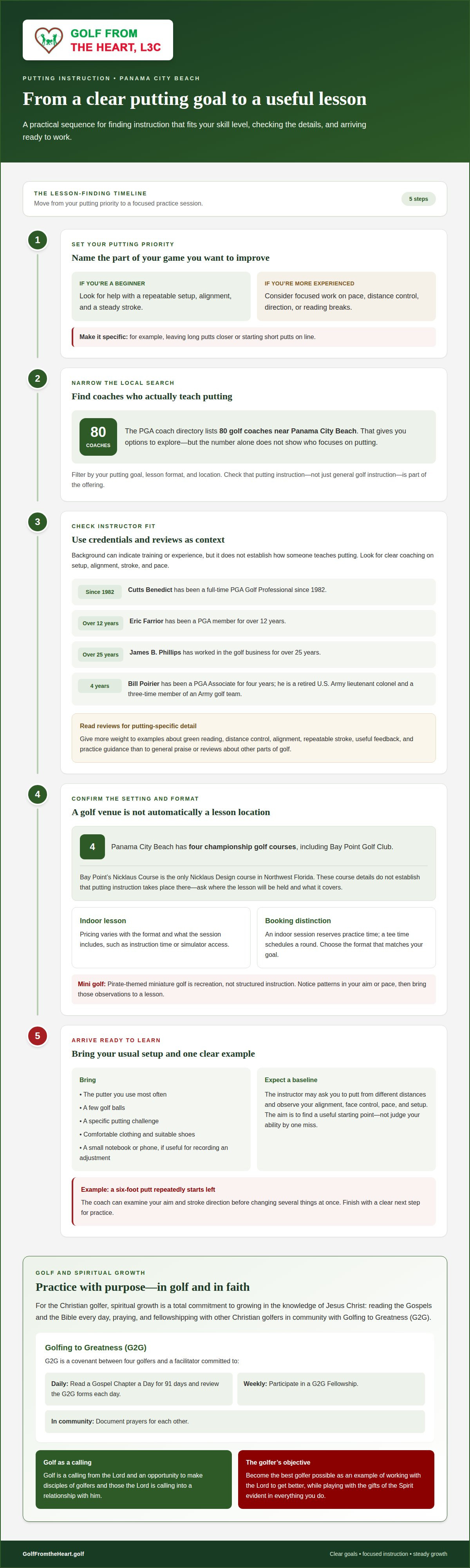
Start with the skill you want to build. For putting lessons near me in PCB, narrow your search to instructors who teach putting, then compare lesson formats, location, and practice goals. The PGA coach directory lists 80 golf coaches near Panama City Beach. That gives beginners and experienced players options to explore, but the number alone doesn’t show who focuses on putting.
Choose an instruction format that matches your level and the challenge you’re addressing. A beginner might need help with setup, alignment, and a steady stroke. A more experienced player might work on distance control or reading breaks. Before a lesson, identify a specific example, such as leaving long putts closer or starting short putts on line. That focus makes instruction more useful than a general practice session.
Panama City Beach has four championship golf courses, including Bay Point Golf Club. Its Nicklaus Course is the only Nicklaus Design course in Northwest Florida. These details point to local course options, but don’t establish that putting instruction takes place there. Keep course choice and lesson arrangements separate when planning. Ask whether instruction will take place on a putting green or another practice area, and what skills it will address.
Pirate-themed miniature golf in Panama City Beach offers a playful putting challenge with friends. It’s recreation, not structured golf instruction. Enjoy it as a coastal outing, and notice simple patterns, such as whether your aim changes on curves or your pace varies across surfaces. Those observations can help you describe your goals during a lesson without mistaking a themed course for a coaching program.
Indoor golf lessons offer another setting, especially if you want focused practice away from an outdoor course. Indoor pricing varies with the lesson format and what the session includes, such as instruction time or simulator access. Booking also differs by activity: an indoor session reserves practice time, while a tee time schedules a round. Match the booking to your goal: choose a putting lesson for stroke feedback and a tee time to play with friends.
- Choose a lesson format based on your putting goal and experience level.
- Separate the course you want to play from where instruction is offered.
- Use miniature golf as recreation, and bring specific practice observations to a lesson.
What qualifications and reviews do nearby putting instructors have?
Instructor credentials can indicate professional training, industry experience, or a competitive background, but they don’t all mean the same thing. In Panama City Beach, compare each qualification with your goal. Putting instruction should include clear coaching on setup, alignment, stroke, and pace, not just a lengthy golf résumé.
Nearby professionals have varied experience. Cutts Benedict has been a full-time PGA Golf Professional since 1982. Eric Farrior has been a PGA member for over 12 years. James B. Phillips has worked in the golf business for over 25 years. These details provide context, but they don’t establish how each coach teaches putting. Look for evidence that instruction addresses the part of your game you want to develop.
Other backgrounds can offer useful context, too. Bill Poirier is a retired U.S. Army lieutenant colonel and a three-time member of an Army golf team. He has been a PGA Associate for four years. This describes his military and golf experience, but doesn’t, by itself, show whether a lesson suits a beginner or advanced player. Consider credentials alongside the lesson’s focus and teaching approach.
Reviews are most useful when they describe specific experiences rather than simply praise an instructor. Look for comments about what the golfer worked on, how feedback was given, or whether a practice plan was easy to understand. A review about driving or course management may say little about putting instruction. Give more weight to examples involving green reading, distance control, alignment, or a repeatable stroke.
Use a simple evaluation process before choosing:
- Match credentials to your needs. Note PGA membership, professional experience, or other stated qualifications, then identify your putting priority.
- Read for teaching detail. Look for examples of clear explanations, useful feedback, and practice guidance.
- Separate background from fit. Years in golf establish experience, while lesson focus and communication help show whether the instruction suits your level.
Finally, turn your goal into a specific lesson topic. For example, say you want to improve pace on long putts or start short putts on line. That gives the instructor a practical focus and helps you judge whether the session addressed your need. Golfers seeking instruction that connects skill development with spiritual growth can explore faith-centered golf guidance.
What should I bring or expect at a putting lesson?
Bring the putter you use most often, a few golf balls, and a specific example of a putting challenge. You might leave long putts short or struggle to start short putts on line. Using your own equipment lets the instructor observe your usual setup and stroke. If you use a different putter for practice, bring that one as well.
Wear comfortable clothing and shoes suited to the lesson setting. On a putting green, choose footwear that lets you stand and move comfortably. For an indoor session, follow the facility’s instructions about equipment and access. A small notebook or phone can help you record a key adjustment, but keep your attention on the demonstration and your response.
A productive lesson often begins with a baseline. The instructor may ask you to putt from different distances, then observe your alignment, face control, pace, and setup. The aim is to find a useful starting point, not judge your ability by one miss. If a six-foot putt repeatedly starts left, for example, the coach can examine your aim and stroke direction before changing several things at once.
Instruction often moves from observation to practice. A coach may demonstrate a setup adjustment, have you repeat the motion, then compare the result with your starting pattern. Ask for one clear practice cue you can remember, such as keeping your eyes steady through the stroke. You can also ask how to adapt the drill for different distances or slopes. That helps you take the lesson from the practice green to a round.
Before the session, prepare a concise description of your goal and experience. “I want better pace on long putts” gives the instructor a more useful starting point than “I want to putt better.” Share any physical comfort needs that affect your stance or grip. During the lesson, speak up if a cue is confusing, and try the movement before deciding whether it helps.
- Bring: your regular putter, balls, and one example of a challenge.
- Notice: the coach’s observations about setup, aim, and distance control.
- Leave with: a simple drill and a cue for your next practice session.
For an evaluation and lesson grounded in your golf goals, explore a focused golf lesson and prepare to describe the part of putting you want to strengthen.
GolfFromtheHeart.golf: Golf From the Heart Evaluation and Golf Lessons
Golf From the Heart offers the Golf From the Heart Evaluation and Golf Lessons for golfers who want to grow in skill and faith. For Christian golfers, golf is a calling from the Lord and an opportunity to make disciples of golfers and those the Lord is calling into relationship with Him. Working to become the best golfer you can be can reflect how you partner with the Lord in improving your game.
Golfing to Greatness (G2G) Local & Online supports spiritual growth and fellowship with other Christian golfers in community. G2G is a covenant between four golfers and a facilitator: read a Gospel Chapter a Day for 91 days, review the G2G forms each day, participate in a G2G Fellowship each week, and document prayers for one another. This commitment, alongside daily reading of the Gospels and the Bible and prayer, helps golfers grow in the knowledge of Jesus Christ.
As you develop your game, seek to show the gifts of the Spirit in everything you do, on and off the course.
Carry Your Practice Forward with Purpose
Begin your next practice with one clear intention: choose an aspect of putting to strengthen, then work on it with patience. Finding putting lessons near me in PCB can turn that goal from a vague hope into focused instruction. Progress comes through attention, reflection, and steady effort, not a single perfect round.
For a Christian golfer, improvement can also reflect a deeper commitment to grow in the knowledge of Jesus Christ. Let the discipline you bring to the green support how you serve others, build community, and respond to your calling. Skill and faith can grow together through purposeful practice.
If you’re ready to consider a lesson as your next step, get in touch with GolfFromtheHeart.golf about your golf goals. Bring the putting challenge you want to work on and a willingness to learn. Take the next stroke with purpose, and keep growing.
Frequently Asked Questions
Which golf courses and instructors near PCB offer putting lessons?
Golf coach listings near Panama City Beach include Patrick Richardson, listed 3 miles away, and Kevin C. Snyder, listed 21 miles away. Eric Farrior is listed 24 miles away. These listings identify nearby golf instructors, but don’t establish each coach’s putting specialty or lesson location. Bay Point Golf Club is a local course option; distinguish course facilities from instructor services when choosing where to learn.
How much do putting lessons cost near Panama City Beach?
Lesson cost depends on the instruction format, session scope, and the learner’s goals. For GolfFromtheHeart.golf lessons, pricing depends on the case and is provided after a quote request. Describe whether you want help with distance control, alignment, or another putting skill, so the request reflects the instruction you’re seeking. A specific lesson price isn’t included here.
Do local instructors offer individual, group, or junior putting lessons?
GolfFromtheHeart.golf offers Golf From the Heart Evaluation and Golf Lessons, as well as the Parents of Junior Golfers 12 - 18 Community. The community is a family connection, while lessons address golf instruction. For a learner, decide whether focused individual attention or learning alongside others better suits their goals, then choose instruction with a putting focus. Junior golfers can also benefit from family support as they develop.
How can I book a putting lesson near PCB, and what is the cancellation policy?
To arrange a lesson with Golf From the Heart in Panama City Beach, contact the organization and describe your putting goal, experience, and preferred lesson format. Discuss cancellation terms when arranging the session, including how schedule changes are handled and what notice is expected. Clarifying those details beforehand makes planning easier for you and the instructor, whether you’re arranging a lesson for yourself or a junior golfer.


