

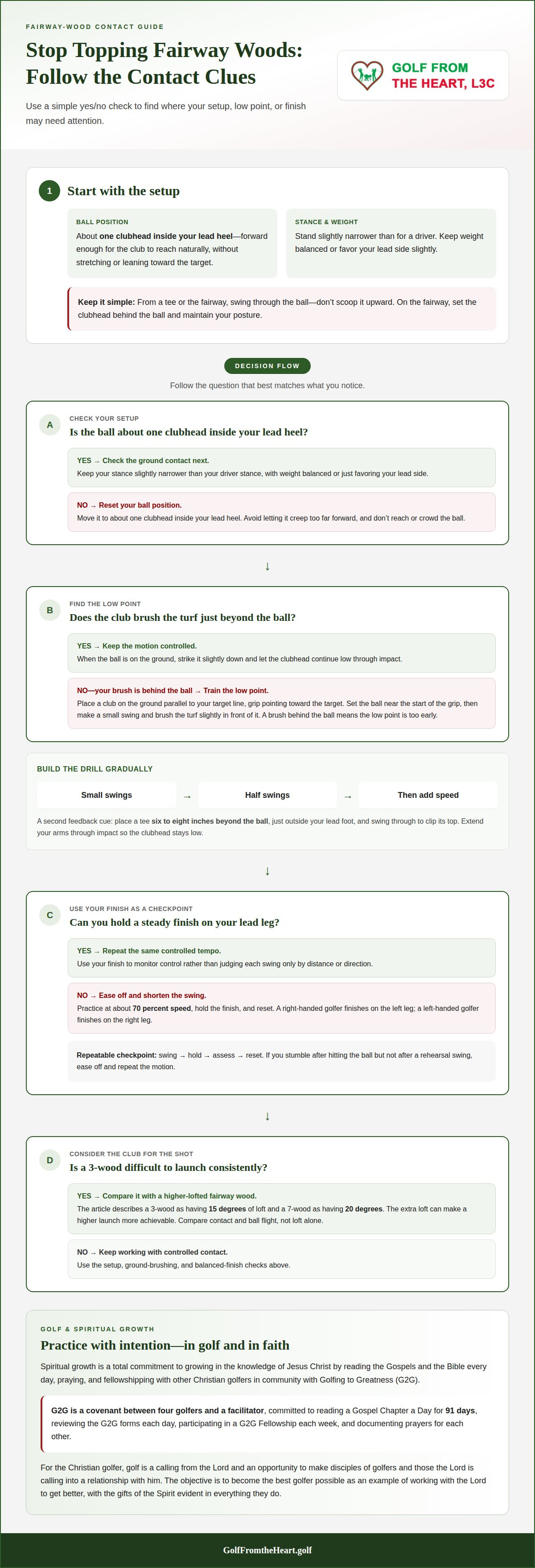
A fairway wood is easier to launch when you stop trying to lift it. Learning how to stop topping fairway woods starts with a reliable setup: position the ball about one clubhead inside your lead heel, then swing through so the club brushes the ground just beyond it.
It’s frustrating when a shot skims along the turf instead of carrying toward your target. The fix often isn’t a harder swing. Give the club room to reach the ball and keep your swing’s low point in the right place.
Here, you’ll learn to adjust your ball position and stance, use a ground-brushing drill to guide your low point, and check your finish for balance. You’ll also see why a higher-lofted fairway wood may help. Patient practice can sharpen your skills while reminding you that growth in golf, like growth in faith, takes intention.
Key Takeaways
- Set a slightly narrower stance than your driver stance, with your weight balanced or just favoring your lead side.
- Use a club on the ground to guide your setup, then practice brushing the turf slightly in front of the ball.
- Make controlled swings and finish balanced on your lead leg: left for right-handed golfers, right for left-handed golfers.
- If a 3-wood is difficult to launch, consider whether a higher-lofted fairway wood, such as a 7-wood, better suits the shot.
Fairway-wood setup and ball position
Start with a repeatable setup: place the ball near your lead heel, then let the club swing through it. Small adjustments can help the club meet the ball instead of catching only its top.
-
Set fairway wood ball position
Position the ball about one clubhead inside your lead heel. This puts it forward enough for the club to reach naturally, without making you stretch or lean toward the target. Keep your stance slightly narrower than your driver stance, with your weight balanced or favoring your lead side slightly. Check that the ball hasn’t crept too far forward, since that can make solid contact harder to find.
-
Adjust setup for tee and fairway shots
From the tee, keep the ball near the same lead-side position and let the tee support it. Make a smooth swing through the ball rather than scooping it upward. From the fairway, the ball rests on the ground, so set the clubhead behind it and maintain your posture. In either case, aim to contact the ball cleanly, not to make a different, upward swing from the fairway.
- Check your stance before swinging. Set your feet slightly narrower than for a driver and distribute your weight evenly, or let it favor your lead side slightly. This gives you a stable base without leaving your weight on your trail foot. Keep your arms relaxed and allow room for them to extend through impact. Avoid reaching for the ball or crowding it, since either can disrupt your swing path and contact.
- Notice why the club is missing the ball’s center. Golfers often top fairway woods when their arms fold and shorten through impact, pulling the clubhead upward. Trying too hard to keep your head down can also restrict the space your arms need to extend. Before each swing, settle into your setup and focus on extending through the ball. A clear setup cue can replace a last-second attempt to lift the shot.
Ground-brushing drill for low-point control
Train the club to reach the turf just beyond the ball, rather than bottoming out too early. This drill helps you notice where your swing meets the ground.
-
Practice brushing the ground
Place a club on the ground parallel to your target line, with its grip pointing toward the target. Set the ball near the start of the grip, then make a small swing and brush the turf slightly in front of it. If you brush behind the ball, your swing’s low point is too early. Keep the movement controlled before adding speed.
-
Build solid fairway-wood contact
Start with small swings, then progress to half swings before adding speed. When the ball is on the ground, strike it slightly down and let the clubhead continue low through impact. Your swing’s low point should be roughly in line with your lead shoulder. Avoid hanging back on your trail foot, which can move the bottom of your swing behind the ball and lead to a topped shot.
-
Check steep and shallow swing paths
Focus first on where the club brushes the ground, rather than forcing a steep or shallow path. Either swing shape can produce poor contact if the club reaches its low point behind the ball. Use the ground mark as feedback: a brush behind the ball signals an early low point, while a brush just ahead shows the club is reaching the intended area.
For another feedback cue, place a tee six to eight inches beyond the ball, just outside your lead foot. Swing through and clip the top of the tee. Extend your arms through impact so the clubhead stays low. If your arms fold, the club can rise and miss the tee. Keep the motion smooth as you build speed.
Return to this golf practice routine as you refine where the club meets the turf.
Balanced finish as a swing checkpoint
Use your finish to assess whether your fairway-wood swing stayed controlled through impact. Practice at about 70 percent speed, then check whether you can hold your balance.
- Make a fairway-wood swing at about 70 percent speed and hold your finish. Pause long enough to notice whether your body is steady or needs a step to regain balance. A controlled finish gives you a useful checkpoint for your motion, rather than a reason to swing harder. Repeat the same tempo so your balance is easier to assess from swing to swing.
- Finish on your lead leg. For a right-handed golfer, that’s the left leg; for a left-handed golfer, it’s the right leg. Notice whether your weight has moved toward that side or whether you’re still leaning back over your trail foot. If you can’t hold the position, slow down and make a shorter, balanced swing before adding speed.
- Check your balance immediately after each shot, before focusing on distance or direction. Ask yourself whether you finished upright and steady, or fell away from the target line. A repeated loss of balance can signal that your motion is rushed or that you’re trying to add force. Return to a smooth swing at 70 percent speed and hold the finish again.
- Use the same finish checkpoint with practice swings and ball strikes. First make a controlled rehearsal, then hit a fairway wood with the same tempo and a balanced finish. Compare the two. If you stumble after hitting the ball but not after rehearsing, ease off and repeat the motion. This comparison helps you notice when trying to hit harder affects your control.
- Build the checkpoint into a short practice sequence: swing, hold, assess, then reset. Focus on your lead leg and steady finish rather than judging each shot by its result. A balanced finish won’t identify every cause of a topped shot, but it gives you a clear, repeatable sign to monitor as you refine your swing.
Using higher-lofted fairway woods
Test a higher-lofted fairway wood when a 3-wood is difficult to launch consistently. Compare contact and ball flight, not loft alone, to find a club that supports a controlled swing.
- Use loft as a practical option, not a shortcut around sound contact. A 3-wood is described as having 15 degrees of loft, while a 7-wood is described as having 20 degrees. The extra loft can make a higher launch more achievable. If you struggle to get a 3-wood airborne from the ground, try a higher-lofted club and assess whether its launch and contact suit your swing.
- Compare the clubs from the same type of lie and with a similar swing. Notice whether the 7-wood launches more easily and whether you can make consistent contact. A useful choice fits the shot you need and the motion you can repeat, rather than simply carrying the lowest number on its sole. Keep your attention on control as well as distance.
- Choose loft and length by observing your setup and strike. The right loft can help you launch the ball with a repeatable swing; the right length lets you stand comfortably, reach the ball without crowding, and maintain balance as you swing. Compare fairway woods with the same ball position and steady tempo, then note which combination supports reliable contact.
- Avoid trying to manufacture height by de-lofting a 3-wood and striking steeply downward. That combination can reduce its effective loft; a 3-wood with 15 degrees of loft could be reduced to about 10 degrees during a descending strike. Instead, let the club’s loft do its work and swing through the ball. A higher-lofted fairway wood may be a better fit when that motion produces more dependable contact.
- Make your decision from the shot you can repeat, not one unusually good result. Compare how each club launches the ball and how confidently you can swing it from the ground. For personal golf swing guidance, use an evaluation to work through your fairway-wood choices.
GolfFromtheHeart.golf
GolfFromtheHeart.golf connects golf improvement with spiritual growth through Golf From the Heart Evaluation and Golf Lessons. For Christian fellowship, Golfing to Greatness Local & Online supports a commitment to growing in knowledge of Jesus Christ through daily Bible reading and prayer.
Golf can be a calling from the Lord and an opportunity to make disciples. The Christian golfer seeks to become the best golfer possible, working with the Lord to improve and showing the gifts of the Spirit in every part of life. Golfing to Greatness (G2G) is a covenant between four golfers and a facilitator: read a Gospel chapter a day for 91 days, review G2G forms daily, join a weekly G2G Fellowship, and document prayers for one another.
If you’d like to explore golf growth grounded in faith, contact GolfFromtheHeart.golf.
Carry Your Practice Into the Next Round
Learning how to stop topping fairway woods is part of a broader practice: noticing what your swing teaches you and responding with patience. Rather than judging yourself by one shot, pay attention to your habits on the course and the care you show your playing partners. Steady improvement in golf can go hand in hand with a Christian commitment to grow in faith and serve others.
For support that brings golf development and spiritual growth together, GolfFromtheHeart.golf offers Golf From the Heart Evaluation and Golf Lessons, along with a community for continued growth. Take the next step by exploring an evaluation, lessons, or Golfing to Greatness, and keep practicing with purpose.
Contact GolfFromtheHeart.golf to explore a thoughtful next step. May each round deepen your skill, patience, and care for others.
Frequently Asked Questions
How should ball position and stance be set up for fairway woods?
Set the ball forward in your stance, with your feet stable and your weight balanced. Rehearse your setup without a ball, then step in and check that the clubhead can reach the ball without stretching or crowding. From a tee or turf, maintain that comfortable posture and adjust only as needed for the lie.
How do posture, spine angle, and weight shift affect topping fairway woods?
Stable posture gives your arms room to swing through, while a sudden change in your spine angle can alter where the club meets the ground. Staying back over your trail foot may move the swing’s low point behind the ball. Let your weight move toward your lead side through impact, and avoid lifting your chest early or forcing your head down.
What drills help stop topping fairway woods?
Use practice swings to find a repeatable contact point before hitting balls. Make a slow rehearsal, notice where the club brushes the turf, then repeat with a ball while keeping the same rhythm. In Panama City Beach, alternate rehearsals and ball strikes during practice so you can notice whether your motion changes when you focus on the target.
What common setup mistakes lead to topping fairway woods?
Common errors include reaching too far, crowding the ball, shifting your weight away from the target, and trying to scoop the club upward. Each can change your contact point or restrict your motion. Before swinging, check that your arms hang comfortably and your stance feels stable. If you feel cramped or off balance, reset instead of trying to correct your setup during the swing.


