

What if a good round measured more than the number on your scorecard? Golfing with a higher purpose pairs the effort to improve your game with attention to the mental habits and spiritual commitments you bring to the course. A thoughtful practice session can strengthen your golf skills while building patience, focus, and humility, qualities that shape how you play and relate to others.
You may already know that practice matters, but hitting balls without noticing your decisions or reactions can leave important lessons unseen. Purposeful practice brings those moments into focus: track behaviors such as staying present, responding calmly after a poor shot, and following an intentional routine. For a Christian golfer, growth also means deepening your knowledge of Jesus through the Gospels and Bible, prayer, and fellowship with other Christian golfers.
Here, you’ll learn what purposeful golf practice involves, how to record mental behaviors alongside your score, and how to read birdies, eagles, and albatrosses. A birdie is one stroke below par, an eagle is two strokes below par, and an albatross is three strokes below par. Together, these ideas can help you approach golf as an opportunity to grow in skill and live out your faith.
Key Takeaways
- Learn how golf charities and nonprofit organizations connect the game with service, community, and fundraising.
- Understand practical ways golfers can take part in charity events and support a cause through play.
- See how purposeful practice can bring mental habits into focus alongside golf skills.
- Explore how Golfing to Greatness connects fellowship, daily Bible reading, prayer, and growth in golf.
Which golf charities and nonprofit organizations support causes through golf?
Golf can bring a nonprofit’s supporters together around a shared mission. The organization might serve young people, address health needs, support veterans, or connect a faith community with its neighbors. Each cause can use golf differently. A youth program, for example, might use a clinic to introduce young people to mentors. A health nonprofit could gather supporters around its mission. The organization’s purpose should shape the golf activity, so participants understand whom it serves and why the gathering matters.
Youth-serving nonprofits can connect golf with mentoring, recreation, or education. A golf activity creates a setting where young people and adult volunteers can interact around a shared interest. For example, a youth group might pair instruction with conversation about teamwork and perseverance. Health-focused organizations can use a golf gathering to bring supporters together and explain their work. A veterans’ organization might hold a community golf event to build connections around its mission. These are possible approaches, not claims about specific organizations.
Faith communities can also use golf as a setting for service, fellowship, and discipleship. For a Christian golfer, golf can be a calling from the Lord and an opportunity to make disciples, including among those the Lord is calling into a relationship with him. The course creates space to build relationships through shared play and conversation. Faith can show through patience, kindness, and humility while you continue working to improve. In this way, the game can support personal growth and meaningful relationships.
Golf-based support can take different forms, depending on a nonprofit’s mission. The organization can choose an activity that fits its purpose:
- Youth development: A mentoring organization could use a clinic to introduce participants to golf and supportive adults.
- Health awareness: A health nonprofit could gather supporters through a golf event and share information about its mission.
- Veterans’ services: A community organization could use golf to create connection among veterans and local supporters.
- Faith outreach: A church or ministry could welcome golfers into fellowship and create opportunities for discipleship.
- Community support: A local nonprofit could bring volunteers and supporters together around a cause they share.
In every example, the nonprofit’s work should remain central. A youth event should make its connection to mentoring or development clear. A faith gathering should communicate its purpose openly and treat participants with respect. This clarity helps golfers understand how the activity connects to the cause. It also gives organizers a sound basis for explaining the intended benefit without overstating what one day of golf can accomplish.
A golf-related initiative also needs thoughtful organization. Ministry teams may need to align the event’s message and audience with the people responsible for carrying it out. Clear communication helps participants see how the activity supports the mission. Golf can then become more than a recreational setting: it can help people meet, serve, and build relationships around a cause. The nonprofit’s mission provides direction, while the game offers a shared way to bring people together.
The scale and history of golf can help a nonprofit explain why the game is a recognizable setting for gathering, while keeping its own cause at the center. Modern golf originated in 15th-century Scotland. Golf was played at the Olympic Games in 1900 and 1904 and has been included since 2016. A standard golf set contains seven numbered irons, from 3 through 9, plus a pitching wedge. These details can serve as conversation starters, but they do not replace a clear account of the organization’s work. Organizers can make the purpose visible in invitations, opening remarks, and follow-up, and can ensure that the activity suits the people they hope to welcome.
The breadth of course availability also offers context for planning, without implying that every location has the same access or that a nonprofit should choose a particular format. The United States had 16,752 golf courses in the figures presented on the page, while the worldwide total in the page's golf-course table was 38,864 courses. The United Kingdom had 2,633 golf courses in the figures presented on the page. Nonprofits can use local knowledge to decide whether a course, practice area, or informal gathering best fits participants and mission. Whatever format is chosen, the cause should be easy to understand, participation should feel welcoming, and any fundraising or outreach should be explained plainly. Golf is the setting; the organization’s service and the relationships built around it are the reason to gather.
How can golfers participate in charity golf events or fundraisers?
Start by choosing a cause that matters to you. A youth program, health nonprofit, veterans’ organization, or faith community may use golf to bring supporters together. Look for an event with a clear purpose, such as funding mentoring or connecting golfers with a local ministry. A good fit lets you enjoy the game while understanding whom the gathering serves. It also gives you a natural way to discuss the cause with playing partners.
Once you find an event, decide how you can contribute. Playing is one option, but golfers can also invite a team, volunteer, or share event information. For example, a player who knows local business owners might connect organizers with potential supporters. Someone who enjoys welcoming people could greet participants. Match your role to your time, skills, and comfort level, then ask the organizers what support would be useful.
Before registering, read the event details carefully. Note the date, location, format, registration steps, and what participation includes. If the event uses a team format, coordinate with your playing partners and make sure everyone understands the schedule. Find out how the organizer will explain the cause during the event. Knowing its purpose helps you speak about it accurately, rather than relying on assumptions or repeating details you haven’t heard directly.
On event day, bring a service-minded attitude along with your clubs. Play with care, welcome golfers you haven’t met, and make room for conversation between shots. If a teammate asks about the nonprofit, share its stated mission and explain why you chose to participate. Avoid turning every interaction into a request for support. Genuine listening can build trust and make a fundraiser feel like a shared community effort, not just a day of golf.
Golfers can support an event through several practical roles:
- Play: Register as an individual or join a team, then take part in the event’s golf format.
- Invite: Share the event details with friends who care about the cause and enjoy playing golf.
- Volunteer: Offer help with participant welcome, event communication, or another organizer-requested task.
- Encourage: Support younger players and newcomers, so they feel included in the day.
- Follow up: Thank organizers and participants, then stay connected to the cause through appropriate opportunities.
For Christian golfers, participation can also reflect a deeper calling. Golf offers a setting for building relationships, which can create opportunities to make disciples. You can pursue improvement as an example of working with the Lord while showing the gifts of the Spirit through your conduct. Patience after a missed shot, kindness toward a beginner, and humility in competition can make faith visible in everyday moments. These actions complement a fundraiser’s practical support with care for people.
Young golfers can take part, too, when an event welcomes their participation. Parents can help junior golfers understand the cause, prepare for the day, and see how their choices affect teammates. For families seeking golf-centered fellowship, a community for junior golfers can connect the game with encouragement and shared growth. Whether you play, volunteer, or invite others, choose a role that serves the event’s purpose and treats each person with respect.
Golf rules allow a golfer to carry up to fourteen clubs in a bag, so check your setup before heading to a fundraiser.
GolfFromtheHeart.golf: Golfing to Greatness Local & Online
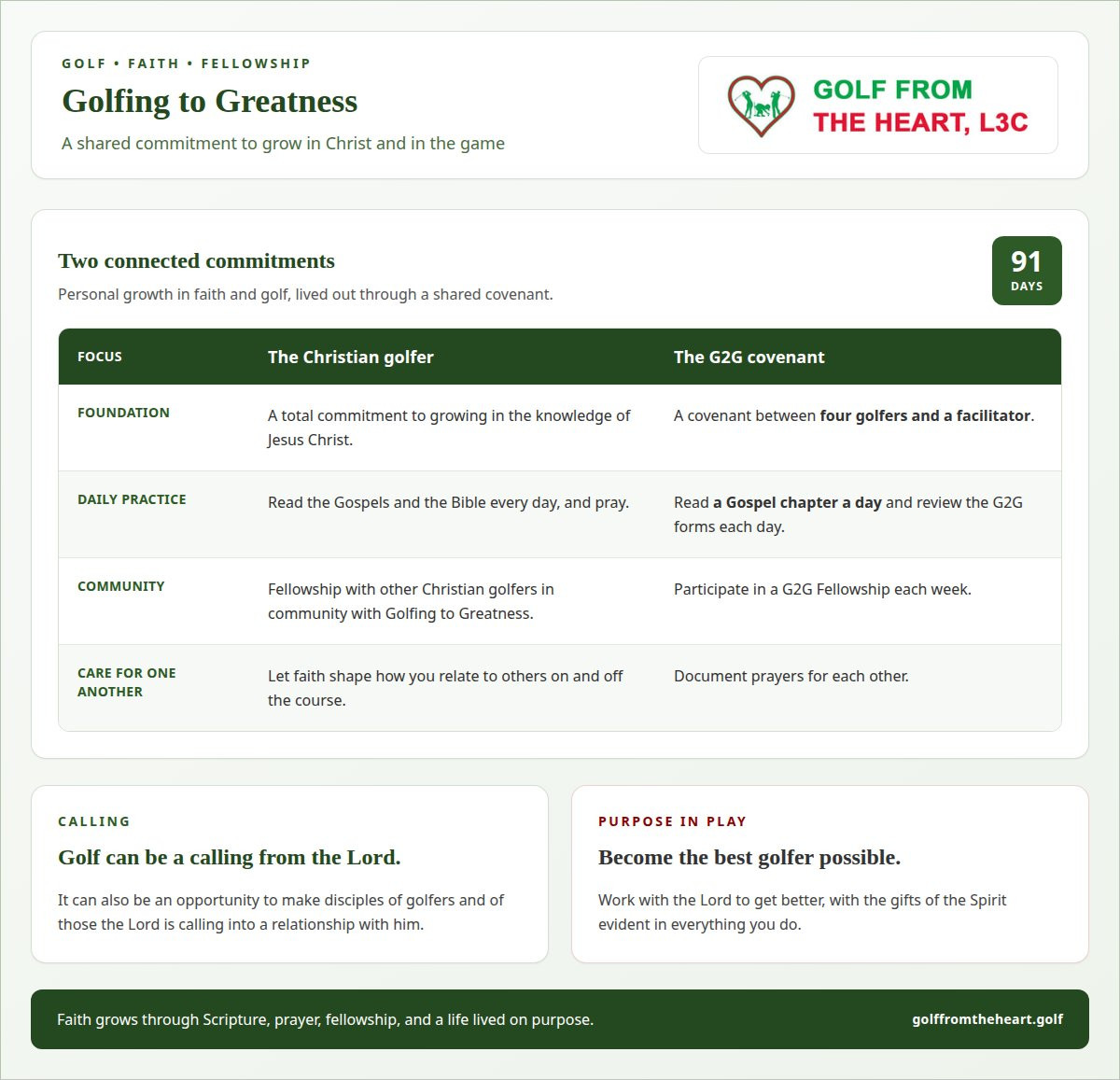
GolfFromtheHeart.golf’s Golfing to Greatness Local & Online connects golf development with Christian fellowship. Golfing to Greatness (G2G) is a covenant between four golfers and a facilitator. For 91 days, members commit to reading a Gospel Chapter a Day and the Bible every day, reviewing G2G forms daily, joining a weekly G2G Fellowship, and documenting prayers for each other. This shared commitment supports growth in knowing Jesus Christ through reading the Gospels and the Bible every day, prayer, and community.
For a Christian golfer, golf can be a calling from the Lord and an opportunity to make disciples. The aim is to become the best golfer possible while working with the Lord to improve, with the gifts of the Spirit evident in daily conduct. Golf From the Heart Evaluation and Golf Lessons may suit golfers seeking skill development; the Parents of Junior Golfers 12 - 18 Community and Camp-Clinic offer options for young players and families.
Contact GolfFromtheHeart.golf to explore a purposeful next step.
Carry Your Purpose Into the Next Round
Let your next round begin with an intention beyond your score. Choose one mental habit to practice, such as patience after a missed shot or gratitude toward a playing partner. Then notice how that choice shapes your attention and relationships on the course. Small, deliberate acts can make golf a setting for serving others, not just measuring performance.
For Christian golfers, golfing with a higher purpose means letting faith guide both the effort to improve and the way you treat people. Make room for prayer, Scripture, and fellowship as part of that growth. The aim is not perfection on the course, but a faithful commitment to keep learning, serving, and reflecting Christ in everyday play.
If you’d like support as you connect your golf journey with spiritual growth, contact GolfFromtheHeart.golf. Take your next step with intention, and let the game become an opportunity to encourage someone else.
Frequently Asked Questions
What Is Purposeful Golf Practice?
Purposeful golf practice pairs a skill goal with deliberate attention to your decisions and reactions. For example, while working on putting, note after each attempt whether you followed your routine and stayed composed. At the end, review both your golf result and your behavior. This helps you choose a specific focus for your next session instead of judging practice only by successful shots.
What does “golfing with a higher purpose” mean?
For a Christian golfer, golfing with a higher purpose means treating golf as a calling from the Lord and an opportunity to serve and make disciples. Spiritual growth involves reading the Gospels and Bible every day, praying, and fellowshipping with Christian golfers. In Panama City Beach, GolfFromtheHeart.golf offers golf lessons and evaluations alongside faith-centered communities and mentorship, helping you pursue growth in both faith and skill.


