

What if the most meaningful moment at your golf event happens after the final putt? A well-planned round can open the door to conversation, connection, and a shared sense of purpose. That’s the heart of golf ministry event planning: bringing people together through golf while creating a sincere, welcoming space for faith and relationships to grow.
It’s natural to feel unsure where to begin. You need a format that suits your ministry and your golfers, while coordinating the venue, volunteers, registration, budget, and event-day details. A scramble can help newcomers feel at ease, but the format is only one part of the experience. The event also needs a clear spiritual purpose that feels genuine rather than added on.
This guide will help you choose a format that fits your goals and participants, organize practical details with clear roles, and create a welcoming experience for golfers at different skill levels. You’ll also learn how to explain the purpose of the gathering, welcome guests, and follow up thoughtfully so connections can continue beyond the course.
Key Takeaways
- Start with the experience you hope participants will have, then choose an event format and activities that support it.
- Use a clear planning sequence to compare an outing, clinic, camp-style activity, or gathering, and assign someone to own each key task.
- Explain the ministry purpose in the invitation, and choose a devotional or reflection that suits the audience without creating pressure.
- Confirm venue details, registration, equipment responsibilities, event communications, and contingency plans before event day.
- Make golf ministry event planning about more than one gathering by offering a relevant, low-pressure next step into community or mentorship.
Start golf ministry event planning with a clear purpose and welcoming audience
A golf ministry event should give people an enjoyable experience and create space for meaningful connection. Those aims can support each other, but organizers need to decide what the gathering is meant to accomplish before choosing activities, a venue, or a format. A clear purpose helps the event feel intentional rather than like an ordinary golf outing with a devotional added at the last minute.
A golf ministry event brings golf together with relationship-building and service. Start by naming who you hope will feel welcome: experienced golfers, beginners, families, church members, community guests, or a mix. That decision shapes the invitation, the pace of the activities, and the support guests may need. For example, a beginner-friendly clinic calls for different instructions and scheduling than a full round for experienced golfers.
Choose the ministry goal before choosing the golf format
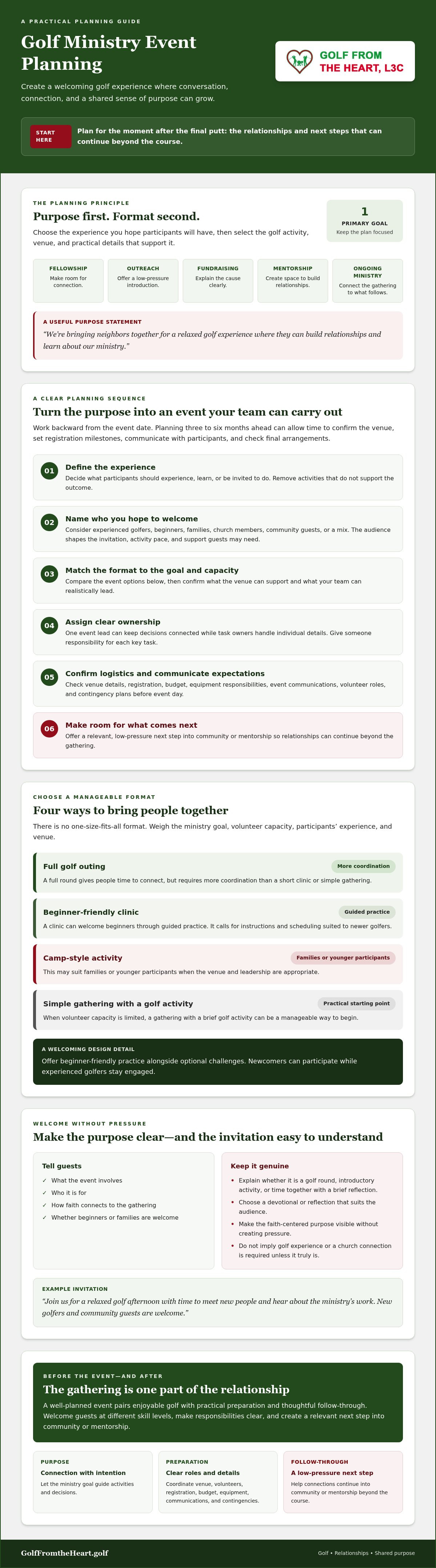
Fellowship, outreach, fundraising, mentorship, and introducing people to an ongoing ministry are distinct goals. An event can support more than one, but choose a primary goal so the planning stays focused. An outreach gathering may prioritize easy conversation and a low-pressure introduction to the ministry. A fundraiser needs a clear explanation of the cause and a straightforward way to invite support.
Write a short purpose statement that the planning team can use to guide decisions. For example: “We’re bringing neighbors together for a relaxed golf experience where they can build relationships and learn about our ministry.” Then ask what participants should experience, learn, or be invited to do. If an activity does not support that outcome, consider removing it.
Clear purpose also gives logistical decisions direction. The broader practice of event management includes planning from the initial idea through coordination and review. For a ministry gathering, each practical choice should serve the people and purpose you’ve identified.
Design an invitation that feels clear and welcoming
Tell guests what the event involves, who it’s for, and how faith connects to the gathering. Be specific about whether the plan is a round of golf, an introductory activity, or time together with a brief reflection. If beginners or families are welcome, say so. Don’t imply that guests need golf experience or a church connection unless that’s genuinely a requirement.
For example: “Join us for a relaxed golf afternoon with time to meet new people and hear about the ministry’s work. New golfers and community guests are welcome.” Clear expectations help guests decide whether to attend and make the faith-centered purpose visible without pressure. Leaders considering how organizational support can strengthen outreach may also find golf outreach ministry support helpful as they shape their approach.
Build a golf ministry event plan from format to event-day roles
Once the purpose and audience are clear, turn them into a plan your team can carry out. Strong golf ministry event planning does not require a complicated production. It does require a suitable format, confirmed logistics, and clear ownership. One event lead can keep decisions connected while task owners manage individual details.
Choose a manageable event format for your ministry
Match the activity to your goal, volunteer capacity, participants’ experience, and venue. A full golf outing gives people time to connect across a round, but requires more coordination than a short clinic or simple gathering. A clinic can welcome beginners through guided practice. A camp-style activity may suit families or younger participants when the venue and leadership are appropriate. If volunteer capacity is limited, a gathering with a brief golf activity can be a practical starting point.
Keep instructions simple and adaptable. For example, offer beginner-friendly practice alongside optional challenges so experienced golfers can stay engaged without leaving newcomers behind. Before settling on a format, confirm what the venue can support and what your team can realistically lead.
Create a timeline and assign event-day responsibilities
Work backward from the event date. Planning three to six months ahead can give you time to confirm the venue, set registration milestones, communicate with participants, and check final arrangements. Use this sequence to turn the idea into an actionable plan:
- 1. Confirm the purpose: Keep the primary outcome visible as plans develop.
- 2. Choose the format: Match the activity to participants, volunteers, and the ministry goal.
- 3. Identify the venue: Ask about rules, accessibility, weather contingencies, and any insurance requirements.
- 4. Assign owners: Name one event lead, then assign individual owners for registration, communications, golf activities, and guest welcome.
- 5. Communicate: Set dates for invitations, reminders, and final confirmations.
- 6. Review: Walk through the schedule, handoffs, and responsibilities before event day.
On event day, clarify who manages check-in, guides guests between activities, answers questions, monitors the schedule, and handles cleanup. Share contact details among team members so volunteers know whom to reach if plans change. Confirm the check-in process and transitions with the venue in advance. Make sure the team understands the weather plan rather than having to improvise.
Clear ownership creates a smoother welcome. When volunteers know what they’re responsible for, guests can focus on the experience instead of the logistics. If your ministry could use help with organization or event communications, explore ministry organizational and marketing assistance as one possible support option.
Address the biggest concern: keeping golf ministry events welcoming and manageable
A faith-centered event can feel uncomfortable if guests discover its spiritual purpose only after they arrive. Clear communication in the invitation helps avoid that. Tell participants whether prayer, a testimony, or a reflection is planned, and explain where it fits in the schedule. Transparency lets people make an informed choice. A warm welcome lets them take part without feeling pressured to respond in a particular way.
Make the faith element sincere, clear, and appropriate
A longer devotional gives the ministry’s message a central place, but it may not fit every audience or event goal. A brief, clearly introduced reflection may feel more natural within a golf gathering while still connecting the activity to the ministry’s purpose. Neither approach is automatically better. Consider who’s attending, how familiar they are with the ministry, and whether the format leaves room for respectful participation or quiet listening.
For example, organizers can introduce a short reflection by explaining why it matters to the gathering, then leave time for conversation afterward. Keep the invitation to engage gentle and voluntary. Faith is shared credibly through words and actions that align, including attentive hospitality, sincere conversation, and respect for each guest.
Plan for inclusion, capacity, and local conditions
Make participation possible for people with different levels of golf experience. Beginners might try a simple putting activity, while guests who do not want to play can still join the conversation and fellowship. Avoid singling anyone out for lack of skill. Choose an event scope your confirmed volunteer team can support instead of adding activities that leave guests waiting or volunteers stretched thin.
For events in Panama City Beach, confirm venue access, seasonal demand, weather plans, and applicable local requirements directly with the relevant venue or authorities. These details can affect what’s practical, so don’t rely on assumptions or a plan used somewhere else.
| Event choice | Volunteer capacity | Participant comfort | Ministry purpose |
|---|---|---|---|
| Full golf outing | Requires coordination across multiple activities and guest needs. | Works best when expectations and support for beginners are clear. | Can allow extended fellowship and conversation. |
| Short clinic or simple gathering | Can be easier to manage with a smaller team. | Offers a lower-pressure way to participate or observe. | Can focus attention on an introduction, reflection, or relationship-building. |
Use the comparison as a guide, not a promise of turnout or outcome. In golf ministry event planning, success is better assessed by the quality of the welcome, the care taken with guests, and whether the gathering reflects its stated purpose, not attendance or fundraising alone.
Prepare the venue, communications, and follow-up before the golf event
Good golf ministry event planning carries through from preparation to the conversations that follow. A confirmed venue and clear participant messages reduce uncertainty on event day. Planned follow-up can help a one-time gathering become the beginning of an ongoing relationship.
Coordinate venue and participant communications
Confirm practical details directly with the venue rather than relying on assumptions. For an event in Panama City Beach, check seasonal availability and travel considerations alongside the location’s access, policies, and weather procedures. Record who on your team is responsible for confirming each item.
- Venue: Confirm the date, arrival and access details, relevant policies, and what happens if weather affects the plan.
- Registration: Explain how guests register, what information you need, and when registration closes or changes must be reported.
- Equipment: Clarify what the venue provides, what participants should bring, and who will handle materials for ministry activities.
- Contingencies: Share the weather plan and any schedule adjustments with the team, then decide how participants will receive updates.
- Communication: Send a confirmation and a reminder with the date, location, arrival guidance, schedule, participation expectations, and an organizer’s contact information.
Keep messages concise and consistent. If guests should expect a reflection or another faith-centered moment, include that information so the event matches the invitation. Make it easy for participants to ask questions before they arrive.
Build follow-up into the event plan
Before the gathering, assign someone to thank participants, share relevant ministry resources, and respond to questions. Follow-up is more than an attendance report. It’s a chance to continue a conversation, recognize the people who helped, and offer an appropriate next step without assuming every guest wants the same kind of connection.
Ask for brief feedback about the golf activity, welcome, schedule, and event communications. Afterward, review attendance, participant comments, volunteer experience, and interest in next steps. Look for useful lessons rather than a predetermined result. Guests may have needed clearer arrival guidance, or volunteers may have found a transition between activities difficult to manage. Decide what to repeat or adjust before planning another event.
If your ministry is considering additional help with its organizational or marketing approach, explore ministry organizational and marketing assistance. Confirm the current scope and availability of support to see whether it fits your needs.
Connect your golf ministry event to lasting community and next steps
A well-hosted event can open the door to connection, but relationships grow through what happens afterward. As part of golf ministry event planning, decide how guests can continue engaging before the gathering ends. The next step should suit the event’s purpose and feel like an invitation, not an assumption that every participant wants the same kind of involvement.
Choose a useful next step for participants
Offer one clear option, such as attending a future gathering, having a ministry conversation, or exploring a mentorship opportunity your ministry provides. Make the invitation specific: explain what it involves, who it may suit, and how to learn more. A beginner-focused event might point toward another opportunity to develop golf skills. An outreach gathering might offer a simple way to continue a faith-centered conversation.
Assign someone to follow up, and tell participants how to respond or decline further contact. For example, an organizer can send a brief thank-you with the promised information and a straightforward way to ask questions. Keep the message consistent with the original invitation. This helps build trust whether a guest chooses to take another step or simply appreciates being welcomed.
Ongoing connection can take different forms, from shared golf activities to a faith-centered community. For a broader look at how those interests can come together, explore the golf and faith community. Use the idea as inspiration, then choose a next step that fits your ministry and participants.
Know when outside ministry support could help
After the event, ask where your team felt stretched. Perhaps it was difficult to keep communications consistent, explain the ministry’s purpose clearly, or coordinate around a shared plan. These are useful signals to consider before the next gathering. They don’t mean you need a larger event or more activities. Strengthening how your ministry organizes and communicates may be the more fitting next move.
GolfFromtheHeart.golf provides organizational, marketing, and communication assistance to golf-based ministries. Confirm the current scope and availability of that support, then consider whether it aligns with your needs. Strong follow-through does not guarantee a particular spiritual, attendance, or fundraising outcome. It does give people a thoughtful opportunity to stay connected through golf, relationships, and faith.
If your ministry is considering support for its organizational, marketing, or communication needs, contact GolfFromtheHeart.golf to discuss whether it may be a fit.
Carry your ministry’s purpose beyond the final putt
Meaningful golf ministry event planning starts with a clear reason to gather and continues through the care participants experience afterward. Choose a format your team can support, explain the faith-centered purpose, and give guests a comfortable way to connect. Thoughtful follow-up can help a single gathering become a starting point for continued fellowship, golf development, or conversation about faith, without assuming what each person needs next.
Keep returning to one guiding question: does each choice serve both the people attending and the ministry’s purpose? When the answer is clear, practical planning becomes more focused and hospitality has room to lead. You don’t need to make the event elaborate to make it meaningful.
GolfFromtheHeart.golf provides organizational, marketing, and communication assistance to golf-based ministries and serves its local community from Panama City Beach. If your ministry is considering support in these areas, explore organizational and marketing support for your golf ministry and confirm whether the current scope fits your needs. Start with purpose, welcome people with sincerity, and let each next step grow from the relationships you build.
Frequently Asked Questions
How do you plan a golf ministry event?
Begin by deciding what you hope participants will experience, then choose a format, audience, and venue that support that purpose. For golf ministry event planning, write down the event’s main goal, assign an owner to each major task, and confirm venue policies and participant needs directly. Share clear expectations before the event, including any faith-centered moments, and decide how you’ll thank guests and continue conversations afterward.
What activities can you include in a golf ministry event?
Choose activities that fit your guests’ golf experience and the ministry’s purpose. A round of golf, beginner-friendly clinic, putting challenge, or short group activity can encourage fellowship without making skill the focus. You might also include a meal, testimony, prayer, or brief reflection if it suits the audience and is explained in advance. Keep the schedule realistic, with enough time for people to talk and move between activities.
How can a golf ministry event welcome people who are not Christians?
Be honest in the invitation about the event’s faith-centered purpose and what participants can expect. Welcome questions, avoid suggesting that guests must share your beliefs to attend, and make any prayer or reflection an invitation rather than a test of belonging. Offer ways to participate without playing golf, and focus on gracious hospitality and genuine conversation. Respectful clarity allows guests to decide how they’d like to engage.
How far ahead should you plan a golf ministry event?
For a golf event, begin planning three to six months ahead when possible. That gives organizers time to form a team, set the budget, check venue availability, choose activities, and communicate registration details. Start earlier if the venue or season makes dates harder to secure, and confirm important requirements directly rather than assuming they’ll remain the same. Set internal milestones for decisions, reminders, and final checks so preparations don’t accumulate at the last minute.
What should a golf ministry event budget include?
List the costs the ministry expects to cover, then confirm rates and terms with the venue and any other providers. Consider course or activity fees, carts if needed, food and beverages, registration or payment processing, supplies, signage, and contingency funds. Record expected income separately, such as participant contributions or sponsorships, if applicable. A clear budget helps leaders choose an event size and format they can responsibly manage without relying on hoped-for fundraising.
How do you follow up after a golf ministry event?
Assign someone to thank guests and volunteers, answer questions, and share any resources or next-step invitation promised at the event. Keep the follow-up personal and relevant rather than sending the same broad appeal to everyone. Ask participants for brief feedback on the schedule, welcome, and activities. Then review attendance, volunteer experience, and interest in further connection to identify what to carry forward or adjust next time.
Can a small church or ministry organize a golf event?
Yes. A small ministry can choose a modest format, such as a short clinic or informal gathering, and keep responsibilities within the team’s actual capacity. Start by checking local venue options and practical conditions in Panama City Beach, then scale activities to the people available to help. GolfFromtheHeart.golf, based in Panama City Beach, provides organizational, marketing, and communication assistance to golf-based ministries. Confirm its current scope and availability if you’re considering support.


