

A slice usually comes from a club path that moves across the ball from outside to inside, often with the clubface open relative to that path. To learn how to fix a golf slice in Panama City Beach, focus on changing the club’s movement through impact rather than trying to steer the ball straight with your hands.
If your shots keep curving right, you may be tempted to change your grip or swing harder. A steadier correction starts with the motion’s sequence: lower the handle, allow a relaxed release, shift pressure toward the target, and rotate your upper body without letting it race ahead of the club.
These adjustments may help you work toward a more controlled relationship between your swing path and clubface. The steps below explain what to feel, which timing errors can disrupt the motion, and how patient practice can support growth in both your game and your character.
Key Takeaways
- Start the downswing by letting the handle lower, helping the club approach the ball on a less outside-in path.
- Keep your grip soft enough for your hands to release through impact, and notice how the clubface points relative to your swing path.
- Shift slightly toward the target to encourage an inside-out path; a simple visual cue can help guide the club’s route.
- Give your lower body time to begin the downswing before opening your upper body, so the club can approach from the inside.
Lowering the club handle first to improve swing sequence
For golfers in Panama City Beach, learning how to fix a golf slice in Panama City Beach starts with changing the club’s route through impact. Lowering the handle before rotating your shoulders can help the club approach from inside the target line.
-
Start the Downswing With the Handle
From the top of your backswing, lower your hands toward your trail hip before turning your chest toward the target. Keep your grip steady, but don’t yank the handle toward the ball. Let your hands descend smoothly, with your shoulders still turned. A stronger grip may help: turn both hands slightly away from the target, with the lines at the base of your thumbs pointing toward the right side of your shirt collar.
-
Recognize an Over-the-Top Swing
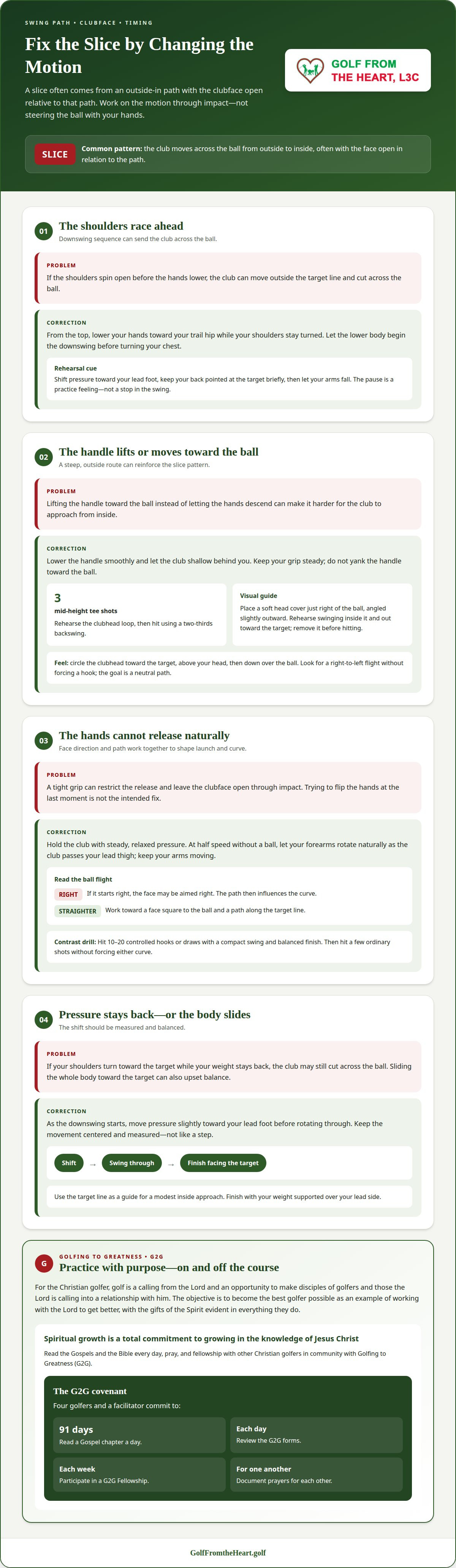
Rehearse a slow downswing and notice whether your shoulders spin open before your hands lower. That over-the-top move can send the club outside the target line and across the ball from outside to inside, creating slice curvature. To feel the opposite path, start with the clubhead in front of the ball, circle it toward the target, above your head, and down over the ball.
At the range, tee up three balls at mid-height. Rehearse the loop, then hit using a two-thirds backswing. Look for a right-to-left flight, but don’t force a hook. The goal is a neutral path, not an exaggerated inside swing.
-
Shallow the Club’s Swing Plane
As your hands lower, let the club shallow behind you instead of lifting the handle toward the ball. A soft head cover placed just right of the ball and angled slightly outward can serve as a visual guide. Rehearse swinging inside the cover and out toward the target, then remove it before hitting.
To work on how to fix a golf slice in Panama City Beach, practise this cue slowly before adding speed. Keep your balance and notice whether the club approaches from inside without striking the guide or cutting across the ball.
Releasing the hands through impact
At impact, the clubface and swing path work together to shape the ball’s launch and curve. Hold the club lightly enough for your hands to release naturally, then use controlled shots to notice whether the face stays open or squares toward the target.
- Hold the club with steady, relaxed pressure and rehearse at half speed without a ball. As the club passes your lead thigh, let your forearms rotate naturally rather than locking your wrists. A tight grip can restrict this release and leave the clubface open through impact. Keep your arms moving, and don’t try to flip your hands at the last moment.
- Hit a short shot and watch the ball’s initial direction as well as its final curve. A clubface pointing right of the target can send the ball right at launch; the swing path then influences its curve. For a straighter shot, work toward a face square to the ball and a path along the target line. Change one feeling at a time, such as using softer fingers or smoother forearm rotation, so you can tell what affects contact.
- Rehearse the opposite curve before returning to your usual slice motion. Hit 10-20 controlled hooks or draws, using a compact swing and balanced finish. These shots help you feel the hands releasing and the face closing relative to the path. Then hit a few ordinary shots without forcing either curve. If the ball starts left and hooks sharply, soften the release; if it launches right and keeps slicing, the face may remain open.
Shifting toward the target to encourage an inside-out path
Shift slightly toward the target to help the club approach from inside. Keep the movement controlled so you stay balanced and change the path without lunging.
- At address, set your feet comfortably and position the ball in front of you. As the downswing starts, move pressure slightly toward your lead foot before rotating through the shot. This shift can make room for your arms and club to approach from inside the target line. Avoid sliding your whole body toward the target. The movement should feel centered and measured, not like a step.
- Place a soft head cover just right of the ball and angle it slightly outward as a visual guide. Rehearse a slow swing that travels inside the head cover and out toward the target line. If the club strikes it, adjust your path instead of swinging harder. Remove the head cover before hitting balls, and keep the same balanced shift through each practice swing.
- Start with a rehearsal, then hit a controlled shot and notice your balance and the ball’s starting direction. A ball that starts right may indicate that the clubface is aimed right; a ball that curves right can reflect the relationship between face and path. Don’t force the club far inside, as an extreme inside-out motion can send the ball off line. Use the target line to guide a modest change, and finish with your weight supported over your lead side.
For example, if your shoulders turn toward the target while your weight stays back, the club may still cut across the ball. Repeat the small pressure shift before each swing, then notice whether the club passes the ball from inside without upsetting your balance. Keep the cue simple: shift, swing through, finish facing the target.
Delaying upper-body rotation during the downswing
Let your lower body begin the downswing while your chest stays turned away from the target. This timing gives your arms room to deliver the club from inside rather than sending it across the ball.
- Rehearse the transition without a ball: from the top, shift pressure toward your lead foot while keeping your back pointed at the target. Pause briefly, then let your arms fall. The pause is a practice feeling, not a stop in the actual swing. If your shoulders immediately face the target, slow down the rehearsal and keep your chest turned away longer.
- Make a waist-high backswing, then start down with your lower body before turning your chest. Keep your arms in front of your torso as the club moves toward the ball. This sequence helps create space for an inside delivery. Avoid opening your shoulders too early, which can pull the club outside the target line and across the ball.
- Progress from rehearsal swings to short shots, using the same sequence each time. Begin with your back still facing the target, let your hands drop, then rotate through impact. Notice the ball’s starting direction and curve. A shot that starts right and curves farther right may indicate that the face and path still need attention. Don’t chase a dramatic draw by keeping your chest closed through impact.
- Finish each swing in balance, with your chest turning toward the target after the club passes the ball. If you lose balance or feel stuck, shorten the swing and repeat the transition. Move to a three-quarter motion only once your arms fall freely through the shorter swing. Build speed gradually while keeping the same sequence: lower body starts, arms descend, then upper body rotates.
GolfFromtheHeart.golf: Golfing to Greatness Local & Online
GolfFromtheHeart.golf offers Golfing to Greatness Local & Online to support you as you develop your swing alongside your spiritual life. For Christian golfers, golf can be a calling from the Lord and an opportunity to make disciples among golfers and those he is calling into relationship with him. The aim is to become the best golfer you can, working with the Lord to improve and showing the gifts of the Spirit in all you do.
Golfing to Greatness (G2G) is a covenant between four golfers and a facilitator. For 91 days, they read a Gospel Chapter a Day, review G2G forms daily, join a G2G Fellowship each week, and document prayers for one another. This commitment encourages growth in knowing Jesus Christ through daily reading of the Gospels and Bible, prayer, and fellowship with other Christian golfers. If you’d like to pursue golf and faith in community, contact GolfFromtheHeart.golf.
Carry your progress into the next round
Learning how to fix a golf slice in Panama City Beach can become more than a search for a straighter shot. Let each practice session be a chance to pay attention, respond patiently, and keep growing without measuring your worth by the flight of one ball.
As you return to the course, set an intention for how you want to play and treat the people beside you. A thoughtful approach makes room for both skill and character to mature over time.
Carry that purpose into your next round. Stay teachable, value the people you play with, and treat each new shot as an opportunity to move forward with gratitude.
Frequently Asked Questions
What Causes the Golf Slice?
A slice commonly occurs when the club travels across the ball from outside to inside while the clubface points open relative to that path. The ball’s curve reflects the relationship between face and path, not simply how hard you swing. A golfer can make solid contact and still see the ball bend away when the face and path don’t work together.
What causes a golf slice and how can you diagnose it?
An outside-in path and an open clubface at impact are common causes of a slice. To identify your pattern, choose a clear target and observe where the ball first launches and how it curves afterward. Note those observations across several shots, along with your alignment and contact quality. This can help distinguish a recurring swing issue from a setup that changes your aim.
What swing path and clubface drills help stop slicing?
Use a range session of 15-20 minutes to practice controlled fades and draws, gradually working toward a neutral flight. Choose a target for each shot and notice whether the ball starts and curves as intended. Avoid trying to manufacture a dramatic draw. The purpose is to explore how face and path affect flight, then settle on a repeatable motion for straighter shots.
Which golf instructors or academies in Panama City Beach offer slice-fixing lessons?
In Panama City Beach, GolfFromtheHeart.golf offers Golf From the Heart Evaluation and Golf Lessons. The Evaluation includes a 20-minute review of a participant’s faith life and a short practice-area session to evaluate their golf game. Golfers looking for help with a slice can use lessons to work on their swing, while the practice-area session offers a chance to examine their game.
Can equipment such as a draw-biased driver help fix a golf slice?
Equipment adjustments may help address a slice. The article recommends moving adjustable driver weight toward the heel and increasing a 9-degree driver’s loft to 10 or 11 degrees when the clubface stays open through impact.


