

What if the most transformative conversations about faith don't happen in a sanctuary, but while walking the quiet stretch of a par-four fairway? Many golfers feel a deep, internal tug to use their passion for the game as a vessel for something greater, yet they often hesitate because the path forward seems unclear. You might wonder how to balance technical swing instruction with meaningful spiritual mentorship without making the experience feel forced. Learning how to start a golf ministry requires more than just a love for the sport; it demands a strategic vision so that the fairway becomes a bridge to the heart.
It's natural to feel overwhelmed by the logistics of organizational structure or the challenge of inviting a secular audience into a faith-based space. This guide provides the clarity you need to move from a simple idea to a thriving outreach program. We'll walk through the essential steps of launching your ministry, from establishing a solid spiritual foundation to implementing practical marketing strategies that resonate with your local community. You'll discover how to utilize proven models like Golfing to Greatness to ensure your program fosters both athletic skill and lasting spiritual maturity in every participant.
Key Takeaways
- Define a purposeful vision that links physical skill with spiritual maturity so your outreach serves a higher calling beyond the game.
- Navigate the essential logistics of how to start a golf ministry by establishing course partnerships and a sustainable organizational structure.
- Implement mission-driven marketing strategies to invite secular golfers into a transformative faith-based community through digital engagement.
- Integrate professional-grade instruction with heart-centered evaluations to guide participants toward both technical proficiency and spiritual growth.
- Leverage professional mentorship and consulting to ensure your ministry remains a source of life-giving impact while maintaining long-term organizational health.
Defining Your Vision for Golf Ministry Outreach
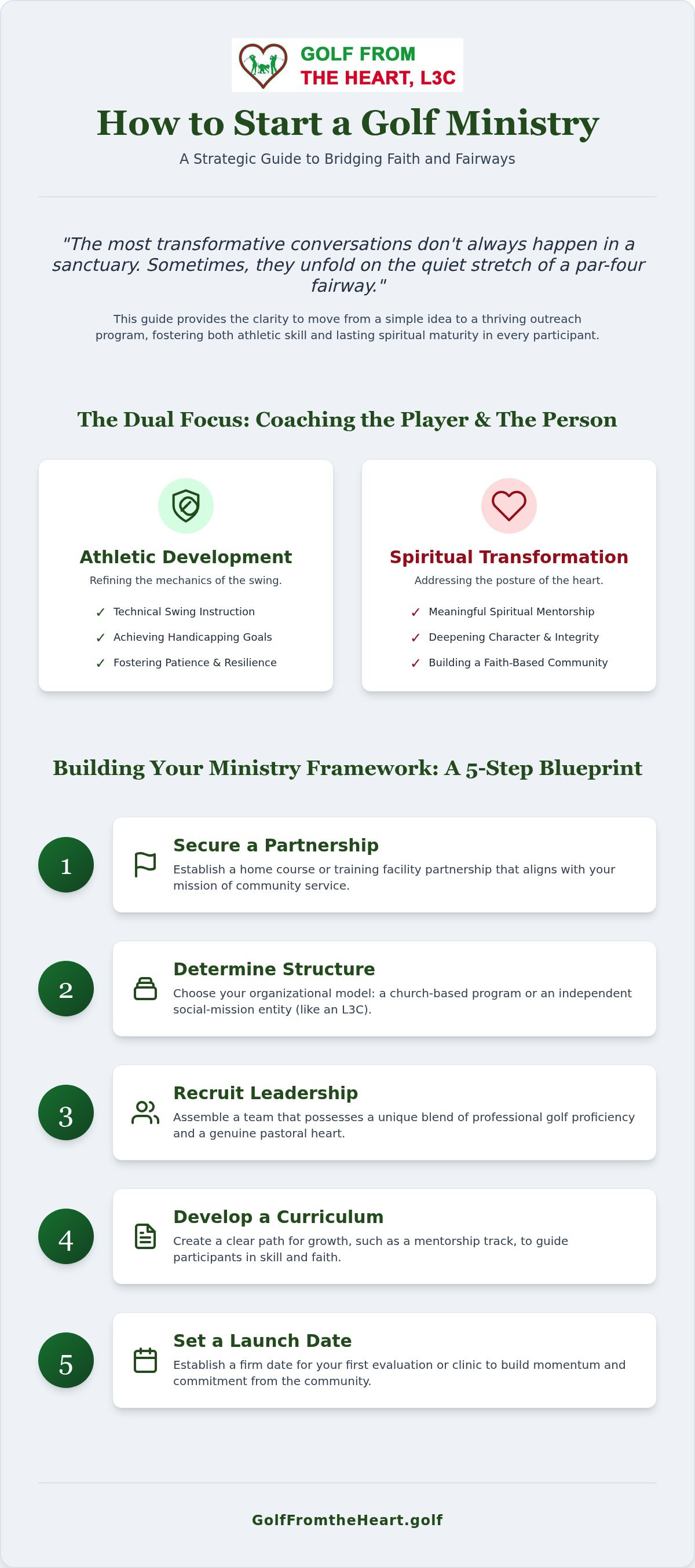
A golf ministry is far more than a social club for the local church; it's the intentional intersection of athletic development and spiritual transformation. By situating faith within the context of a sports ministry, you create a neutral ground where relationships can flourish without the immediate pressure of a formal setting. When you begin exploring how to start a golf ministry, your first step is to recognize that the game is a vehicle, not the destination. We refine the mechanics of the swing so that we can eventually address the posture of the heart.
Identifying your target audience is a critical component of this vision. You might feel called to mentor corporate professionals who need a space for reflection, or perhaps your heart is set on families seeking a shared activity grounded in values. Our work often focuses on specific communities, such as the Parents of Junior Golfers 12-18 community, where the challenges of the game mirror the complexities of raising teenagers. Whether you choose youth outreach or executive mentorship, your goal is to establish clear spiritual objectives that run parallel to handicapping goals. A successful program measures progress by both the consistency of a player's drive and the depth of their character.
Identifying Your Core Mission and Values
Your mission statement should act as a compass, guiding every event and lesson you host. It's vital to balance outward-facing evangelism with inward-facing discipleship. While outreach brings new faces to the tee box, mentorship ensures they grow in their faith long after the final hole. Adopting a social-mission focus can also enhance community trust. For instance, operating as an L3C, a low-profit limited liability company, signals to your audience that your primary goal is social impact rather than maximizing profit. This transparency builds a foundation of integrity that is essential when implementing golf based ministry marketing to a secular audience.
The Role of Golf in Strategic Spiritual Growth
Golf serves as a unique spiritual discipline because it demands patience, honesty, and resilience. The quiet of the fairway facilitates deep, unhurried conversations that are rarely possible in the noise of daily life. As players navigate the hazards of the course, they learn to navigate the distractions of the world with a steady hand and a focused mind. A golf ministry acts as a bridge between a recreational pursuit and an eternal purpose, turning the green into a classroom for the soul. This physical-to-spiritual progression allows you to coach the person, not just the player, ensuring that every round played contributes to a life well-lived.
Strategic Planning: Building Your Ministry Framework
Moving from a heartfelt vision to a functional reality requires a methodical approach to organization. When you're learning how to start a golf ministry, the structural choices you make today will determine the long-term health of your outreach. You aren't just building a sports program; you're cultivating a garden where character can grow alongside technical skill. This phase is about creating a container strong enough to hold your spiritual goals while remaining flexible enough to meet the needs of a diverse golfing community.
To ensure your ministry is sustainable, follow these strategic steps:
- Step 1: Secure a home course or training facility partnership that aligns with your mission of community service.
- Step 2: Determine your organizational structure, choosing between a church-based program or an independent social-mission model.
- Step 3: Recruit a leadership team that possesses a unique blend of professional golf proficiency and pastoral heart.
- Step 4: Develop a curriculum, such as the Golfing to Greatness mentorship track, to provide a clear path for growth.
- Step 5: Set a firm launch date for your first evaluation or clinic to build momentum and commitment.
Choosing the Right Organizational Model
The legal and operational structure you choose serves as the skeleton for your ministry. Many leaders find success through church-led outreach programs so that they can leverage existing congregations and resources for immediate impact. Others prefer the independent L3C model, which focuses on a social mission to reach the broader community beyond traditional church walls. If you are researching how to start a nonprofit or a mission-driven business, remember that the goal is to create a professional presence that invites trust. The intentional practice of using golf for ministry works best when the organization is as disciplined as the swing it teaches.
Facility Partnerships and Logistics
Your choice of venue is your primary classroom. When approaching golf course managers, present a community-benefit proposal that highlights how your ministry will bring new, dedicated players to their facility. Focus on the value of relationship-building and the quiet respect your program will bring to the course. You'll also need to manage practicalities like liability insurance and consistent scheduling. A monthly or seasonal structure often works best, providing a steady rhythm of reflection and practice. If you find the logistical hurdles daunting, seeking ministry organizational and marketing assistance can help you navigate these early stages with confidence and professional clarity.
Marketing and Community Engagement Strategies
Marketing a faith-driven initiative is less about aggressive persuasion and more about creating a welcoming space for those seeking peace and purpose. As you learn how to start a golf ministry, you'll find that your most effective outreach happens when the technical value of the sport meets the emotional and spiritual needs of the player. You aren't just selling lessons; you're offering an invitation to a journey of personal transformation. Utilizing golf based ministry marketing allows you to present your mission with professional clarity while keeping the spiritual message at the forefront of every communication.
Effective engagement also relies on empowering your current members to become bridge-builders. By creating "invitation programs," you give your participants the tools and confidence to bring friends into the fold. This organic growth ensures that the ministry remains grounded in authentic relationships rather than just promotional campaigns. When members share how their game and their perspective have shifted, their personal testimony becomes the most powerful marketing tool you have.
Reaching the Unchurched Through Sport
Many golfers who don't attend traditional church services are still searching for clarity, integrity, and mental focus. You can reach this audience by focusing on "Search Discovery," targeting phrases like "faith-based golf instruction" or "purposeful coaching" in your digital content. Offering a low-friction entry point, such as a Golf From the Heart Evaluation, provides an immediate physical benefit while opening a door for deeper connection. Your messaging should highlight how the game provides a unique reprieve from life's pressures, focusing on how the quiet of the course facilitates a better connection with oneself and the Creator.
Building Local and Online Communities
Integrating Technical Instruction with Spiritual Growth
A golf ministry that ignores the quality of the game misses a vital opportunity for connection. Golfers are naturally driven to improve their performance, and by providing professional-grade coaching, you earn the right to be heard. When you're researching how to start a golf ministry, it's essential to realize that technical excellence is the foundation of your authority. A mentor who can truly help a player find their swing or increase their clubhead speed demonstrates a level of care that opens the door for deeper, more meaningful conversations about faith and character.
The Golf From the Heart Evaluation serves as our primary diagnostic tool for this integrated approach. We don't just look at the physical mechanics of the grip and stance; we also observe the internal spiritual state of the player. By checking both the swing and the soul, we can identify where frustration or pride might be hindering a player's progress on and off the course. This dual-purpose evaluation leads naturally into our Golfing to Greatness mentorship tracks, where we use the mental game of golf to teach Christian principles like patience, honesty, and stewardship. Instruction is the bridge that carries a player from recreational interest to spiritual maturity.
The Authority of Excellence
Your ministry must offer high-quality instruction to remain credible in the eyes of experienced golfers. If the coaching is subpar, the spiritual message may be viewed with similar skepticism. We recommend integrating faith based golf lessons in Panama City Beach as a proven model for skill development. This approach trains mentors to be "coaches of character" as well as swing experts. When a coach provides a solution for a persistent hook or slice, they aren't just fixing a ball flight; they're building a relationship of trust that allows for pastoral guidance.
Mentorship Beyond the Fairway
The goal is to move from technical tips to life-application discussions as the round progresses. We often use the "back nine" of a round for intentional spiritual check-ins, once the initial focus on the score has settled into a rhythm. This transition allows for a physical-to-spiritual progression that feels natural rather than forced. When a player understands how to align their clubface to correct a slice, they often become more open to a discussion about how to align their daily choices with their eternal path. To begin this process of holistic growth, you can invite your community to register for a Golf From the Heart Evaluation, ensuring their journey starts with a clear vision for both their game and their heart.
Sustaining Your Ministry Through Professional Support
Sustainability is the true test of any outreach initiative. While the initial excitement of a launch can carry a program through its first few months, long-term impact requires a steady foundation. When you consider how to start a golf ministry, you must also plan for how to keep it vibrant so that the initial spark matures into a steady flame of community transformation. Seeking golf outreach ministry support is a vital step in preventing the burnout that often sidelines well-intentioned leaders. By leaning on professional consulting, you ensure your organizational unity remains intact as your vision grows.
Scaling your ministry from a local clinic to a regional outreach is a journey of intentional steps. At Golf From the Heart, we provide specialized Ministry Organizational and Marketing Assistance to help you navigate this progression. We help you refine your communication strategies so that your message remains clear as you reach a wider audience. This professional support allows you to focus on the hearts of your players while we help manage the logistics of your mission-driven enterprise. Our goal is to act as your partner in growth, providing the tools you need to maintain excellence in every round.
Avoiding Common Pitfalls in Sports Ministry
One of the most significant challenges in this field is ensuring the program doesn't become "just a golf club." It's easy for the technical aspects of the game to overshadow the spiritual mission. To maintain a focus on the Great Commission, you must implement structured leadership tracks that prepare volunteers to be mentors first and golfers second. Managing volunteer fatigue is equally important; a well-organized framework prevents a few individuals from carrying the entire burden. By distributing responsibility, you create a sustainable environment where everyone can grow in their faith while enjoying the sport.
Partnering for Success
Success in this specialized outreach rarely happens in isolation. You can register for a camp-clinic to experience a training ground where potential leaders learn to balance high-quality instruction with meaningful outreach. These events serve as a model for how to integrate technical skill with spiritual depth in a way that resonates with today's golfers. Accessing organizational help through our community provides you with a network of peers who share your commitment to a higher calling. If you feel ready to take the next step in your journey, you can contact Golf From the Heart for ministry consulting to receive personalized guidance tailored to your community's needs.
Launching Your Fairway Mission with Purpose
Starting a journey of sports-based outreach is an act of faith that requires both a clear vision and a disciplined structure. You've learned that the most effective way to reach others is by bridging the gap between technical proficiency and spiritual maturity. By establishing a solid organizational framework and integrating professional-grade coaching, you create a credible environment where true transformation can take place. Understanding how to start a golf ministry is just the beginning; the real work lies in the steady, day-to-day mentorship that happens on the green.
You don't have to navigate these complexities alone. Whether you're building a local community in Panama City Beach or reaching a global audience online, specialized support can help you maintain organizational unity. Our proven Golfing to Greatness mentorship framework provides a turnkey model for your success. If you're ready to move from vision to action, you can get professional support for your golf ministry outreach. We offer the consulting and marketing expertise needed to ensure your mission thrives for years to come. Your passion for the game is a gift; it's time to use it to serve a higher purpose.
Frequently Asked Questions
Do I need to be a professional golfer to start a golf ministry?
You don't need to be a professional golfer to begin this journey, but you must prioritize technical excellence to maintain credibility. A successful leader often partners with a skilled instructor or utilizes professional evaluations to ensure participants receive high-quality guidance. This allows you to focus on the heart of the ministry while ensuring the physical instruction remains professional so that the spiritual message is received with respect and trust.
How do I approach a local golf course about hosting a church golf ministry?
Approach course managers with a proposal that emphasizes community engagement and consistent facility use. Highlight how your program brings dedicated, respectful players to their course during off-peak hours. By framing the ministry as a partnership that serves the local area, you build a relationship based on mutual benefit. This professional approach helps the manager see your outreach as an asset to their facility rather than just a social group.
What is the best way to incorporate prayer into a golf outing without it feeling forced?
Incorporate prayer by weaving it into the natural pauses of the round, such as before the first tee or during a quiet moment on the back nine. Instead of a formal ceremony, offer a brief, sincere word of gratitude that connects the beauty of the course to the Creator. This physical-to-spiritual progression feels organic so that participants see prayer as a natural extension of their reflection on the fairway rather than a forced interruption.
Is a golf ministry effective for reaching younger generations like teens?
Golf is an exceptionally effective tool for reaching teenagers because it teaches patience and integrity in a tangible way. Specialized programs, such as our community for parents of junior golfers ages 12 to 18, provide a structured environment for both skill development and character growth. By using the game to illustrate life lessons, you engage younger generations in a meaningful dialogue that transcends the typical classroom setting and builds lasting maturity.
How much does it cost to start a small-scale golf outreach program?
The cost of learning how to start a golf ministry varies depending on your organizational structure and facility partnerships. Many small-scale programs begin by securing a group rate at a local range or using public courses to keep initial overhead low. By focusing on a lean, mission-driven model, you can prioritize relationship-building over expensive equipment. For instance, when setting up your donation system, you can explore Transaction-based platform fees to ensure your resources are used as effectively as possible. Seeking professional consulting for organizational assistance can also help you allocate resources efficiently from the very beginning.
Can I run a golf ministry entirely online?
You can certainly run a ministry online by offering digital mentorship tracks and virtual communities. While the physical game happens on local courses, the spiritual growth and community connection can be facilitated through online platforms like our Golfing to Greatness online program. This hybrid model allows you to provide consistent guidance and encouragement to participants regardless of their geographic location, ensuring that the ministry's impact extends far beyond the local driving range.
What insurance do I need for a faith-based sports clinic?
A faith-based sports clinic typically requires general liability insurance to protect the organization, the leaders, and the facility. Even if you operate through a church, it's vital to verify that your current policy covers off-site athletic activities. Ensuring you have the correct coverage demonstrates professional responsibility and builds trust with your host course. Always consult with a licensed insurance professional to tailor a policy that meets the specific risks of your outreach program.
How do I find a curriculum that balances golf skills and Christian values?
Finding a balanced curriculum is essential for maintaining the dual focus of your mission. You should look for frameworks, such as the Golfing to Greatness mentorship track, that intentionally link swing mechanics to spiritual disciplines. A well-designed curriculum ensures that every lesson serves a dual purpose, correcting a physical flaw while simultaneously addressing a character-based goal. This structured approach helps your mentors provide consistent, life-changing guidance to every golfer in your program.


