

You arrive at the driving range with the best of intentions. You have a large bucket of balls, an hour to spare, and a desire to finally fix that slice. But 45 minutes later, you’re left with an empty bucket, a tired back, and the same frustrating ball flight. You’ve hit dozens of shots, but you haven’t truly practiced. You’ve fallen into the range trap—a cycle of repetitive, mindless action that fails to produce lasting results on the course.
This experience is common, but it points to a deeper question that goes beyond swing mechanics: What is the true purpose of your practice? Is it merely to lower a number on a scorecard, or can it be something more? For the Christian golfer, the answer is a resounding yes. Your time at the range can be transformed from a frustrating chore into a powerful act of worship and personal growth.
This guide will introduce you to the framework of purpose driven golf practice. We will explore how to move beyond aimlessly beating balls and begin aligning your physical actions with your spiritual calling. You will learn how to structure your time, focus your mind, and connect your efforts on the range to a mission that extends far beyond the 18th green.
The Range Trap: Why Most Golf Practice Fails
The modern driving range offers a tempting illusion of progress. With a perfect lie for every shot and no real consequences for a miss, it’s easy to feel like you’re improving. However, this environment often encourages a form of practice that is detached from the realities of the game and, more importantly, detached from any meaningful intention. This is the essence of the range trap.
Mindless practice isn’t just ineffective; it takes a toll on your handicap and your mental health. It’s the psychological difference between simply ‘beating balls’—an act of frustration—and deliberate practice, an act of stewardship. While technical drills have their place, they cannot solve a problem rooted in a lack of internal focus. To truly improve, we must transition from a secular ‘hustle’ mindset to a faith-filled ‘purpose’ mindset.
Symptoms of Aimless Practice
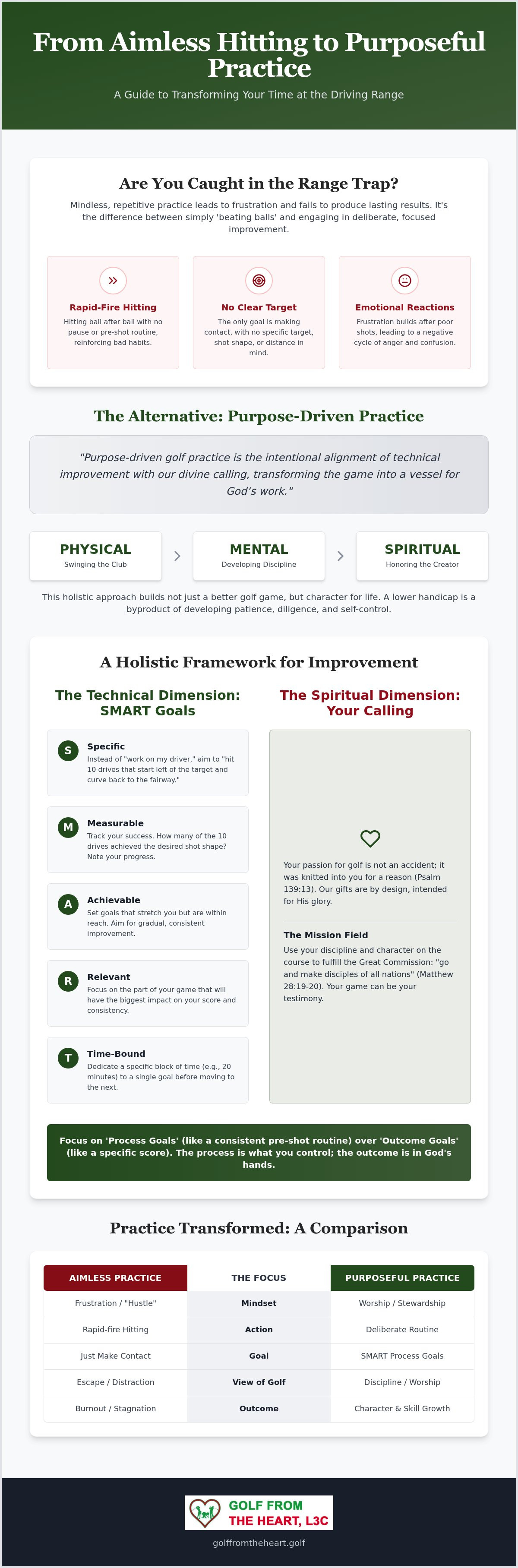
How can you tell if you’re caught in the range trap? Look for these common signs during your practice sessions:
- Rapid-fire hitting: You hit one ball after another with little to no pause, completely abandoning the pre-shot routine you would use on the course.
- Lack of a clear target: Your only goal is to make contact and send the ball forward, without a specific target, shot shape, or distance in mind.
- Emotional reactions: Frustration builds after a ‘bad’ shot, but there’s no process to understand the ‘why’ behind the mistake, leading to a cycle of anger and confusion.
The Missed Calling of Wasted Time
For the believer, time is a precious gift from God, and we are called to be good stewards of it. When we engage in aimless practice, we are doing more than just wasting an hour; we are missing an opportunity for disciplined growth and worship.
- Viewing golf as a distraction rather than a discipline: Aimless practice positions golf as a mere escape, a way to kill time. Purposeful practice reframes it as a discipline that can build character and honor God.
- The connection between stewardship and improvement: When you treat your practice time as a resource to be stewarded, your focus sharpens, and your intention deepens. This mindset is the foundation for real athletic improvement.
- A path to burnout and decreased joy: Mindless repetition without a higher purpose inevitably leads to burnout. It drains the joy from the game because it disconnects the physical act from any spiritual fulfillment.
Defining Purpose Driven Golf Practice: A Holistic Framework
So, what is the alternative? Purpose driven golf practice is the intentional alignment of technical improvement with our divine calling, transforming the game into a vessel for God’s work. It’s a holistic framework that integrates the physical, mental, and spiritual dimensions of the game, recognizing that true excellence is a form of worship.
This approach moves beyond the scoreboard. A lower handicap becomes a byproduct of a more important goal: developing the fruits of the Spirit—patience, diligence, and self-control—on the range so they can be a testament to others on the course. Every practice session becomes a progression, starting with the physical act of swinging a club and elevating to the spiritual act of honoring your Creator.
This intentionality doesn’t just build a better golf game; it builds character for life. The focus and discipline required to master a difficult shot are the same virtues needed to navigate life’s challenges with grace.
The Technical Definition of Purpose
While our ultimate purpose is spiritual, its application on the range must be practical and clear. This begins with setting goals that give structure to our efforts. We can adapt the well-known SMART framework to our practice:
- Specific: Instead of “work on my driver,” a specific goal is “hit 10 drives that start left of the target and curve back to the fairway.”
- Measurable: Track your success. How many of the 10 drives achieved the desired shot shape?
- Achievable: Set goals that stretch you but are within reach. Don’t expect to hit a perfect fade if you’ve never done it before.
- Relevant: Focus on the part of your game that will have the biggest impact on your score and your consistency.
- Time-bound: Dedicate a specific block of time (e.g., 20 minutes) to this single goal before moving on.
Crucially, this framework emphasizes ‘process goals’ (like executing a pre-shot routine) over ‘outcome goals’ (like shooting a certain score). The process is what we control; the outcome is in God’s hands.
The Spiritual Dimension of Purpose
This is the heart of purpose driven golf practice. Our technical efforts are not for our own glory but for His. The Bible tells us that our gifts and passions are by design. Psalm 139:13 says, “For you created my inmost being; you knit me together in my mother’s womb.” Later, in verse 16, it continues, “all the days ordained for me were written in your book before one of them came to be.”
For those of us with a passion for golf, we can trust that this passion was knitted into us for a reason. Our calling is to use it to fulfill the Great Commission: “Therefore, go and make disciples of all nations... teaching them to obey everything I have commanded you” (Matthew 28:19-20). Our mission field can be the fairway. The objective, then, is to become the best golfer we can be as an example of working with the Lord, demonstrating the gifts of the Spirit in all we do.
This transforms practice from a selfish pursuit into a selfless mission. It is grounded in gratitude for the ability to play and fueled by the patience and humility required in the learning process. This is the foundation taught in faith-based mentorship programs, which provide the community and accountability for this framework to flourish.
The Four Pillars of Purposeful Improvement
To build a golf game that is both technically sound and spiritually aligned, we must focus on four interconnected pillars. While secular coaching often stops at the first one or two, a purpose-driven approach understands that all four are essential for lasting growth. The fourth pillar, Spiritual Alignment, is not just one of four; it is the foundation upon which the others are built.
- Pillar 1: Technical Skill (The Mechanics of the Swing)
- Pillar 2: Mental Fortitude (Focus and Emotional Regulation)
- Pillar 3: Physical Stewardship (Body Maintenance and Health)
- Pillar 4: Spiritual Alignment (Core Mission and Character)
Technical and Mental Pillars
The technical and mental aspects of golf are deeply intertwined. A calm spirit allows for a fluid swing, while a chaotic mind leads to a jerky, inconsistent motion. Purposeful practice addresses both simultaneously.
- Developing Motor Control: Instead of rapid-fire hitting, use deliberate, slow-motion drills to feel the correct positions in your swing. This builds muscle memory more effectively than a thousand rushed swings.
- Managing ‘Range Anxiety’: The pressure to perform can exist even in practice. Use this as an opportunity to manage stress through prayerful focus, breathing, and centering your thoughts on your ultimate purpose rather than the result of a single shot.
- Identifying Technical Gaps: It is difficult to see our own swing flaws. A professional Christian golf evaluation can provide the expert feedback needed to create a practice plan that addresses your specific mechanical needs.
Physical and Spiritual Pillars
How we care for our bodies and our spirits directly impacts our ability to perform on the course and fulfill our mission. These pillars are about honoring the gifts we’ve been given.
- Stewardship of the Body: Your body is a temple of the Holy Spirit (1 Corinthians 6:19). Proper mobility, stability, and strength work are not acts of vanity; they are acts of stewardship that enable longevity in the game and in life.
- Spiritual Discipline: The quiet of the driving range can be a sanctuary. Use the time between shots for reflection, prayer, or meditating on scripture. This turns practice into a devotional time. Explore these Bible verses for golfers to guide your reflection.
- Character as a Strategy: Honesty in scoring, patience after a bad shot, and encouragement for a playing partner are not just ‘nice’ things to do. They are a direct reflection of your character and a powerful form of witness. Developing this character begins in practice.
A Step-by-Step Purpose Driven Practice Routine
Knowing the principles is one thing; putting them into action is another. This structured routine transforms a typical 60-minute range session from a mindless exercise into a powerful block of intentional training for your swing and your spirit.
- Phase 1: The Heart Check (5 minutes)
- Phase 2: The Warm-up (10 minutes)
- Phase 3: The Technical Block (25 minutes)
- Phase 4: The Pressure Block (20 minutes)
Phase 1 & 2: Preparing the Heart and Body
Before you hit a single ball, you must prepare the foundation. A calm heart leads to a fluid swing, and a prepared body prevents injury and allows for proper mechanics. This initial phase sets the tone for the entire session.
- Set a Spiritual Intention: Begin with a short prayer, offering your practice time to God. Consider setting a ‘Word of the Day’ for your session, like Patience, Diligence, or Gratitude, to anchor your thoughts. This aligns with the devotional practice of reviewing a chapter from the Gospels each day.
- Honor the Body: Engage in dynamic stretching that prepares your muscles for the golf swing. This isn’t about pushing to the limit; it’s about honoring your body’s current capabilities and preparing it for the work ahead.
Phase 3 & 4: Skill Building and Course Simulation
With your heart and body prepared, you can now focus on the technical and mental aspects of the game. This is where you build skill and then test it under simulated pressure, bridging the gap between the range and the course.
- The Technical Block: Choose one specific swing key or goal for this phase. Use the "10-ball rule": hit no more than 10 balls focusing on that single thought before taking a break or switching clubs. This prevents mental overload and encourages deep learning.
- The Pressure Block: Now, stop hitting to the open range. Play 3-4 holes in your mind. Change your club and target for every single shot. If you hit a 7-iron for your "approach," your next shot is a "chip" or a "pitch." This simulates the rhythm and decision-making of a real round.
- Practice Correction, Not Condemnation: When a shot goes offline during the pressure block, don’t get frustrated. Instead, practice your response. Take a breath, step back, and analyze the 'why' without emotion. This trains you to handle adversity on the course with grace and composure, a powerful witness to your playing partners.
Joining a Community of Purpose in Panama City Beach
While individual practice is essential, true and lasting growth happens in community. The journey of aligning your game with your faith is not one you should walk alone. A mentor can see the blind spots in your swing and your spirit, and a community provides the accountability and encouragement to persevere through challenges.
This is the principle behind the Golfing to Greatness (G2G) community. G2G is not just a group of golfers; it’s a covenant. It typically involves a small group of four golfers and a facilitator who commit to growing together in their knowledge of Jesus Christ. The structure is simple but profound:
- Read one Gospel chapter a day for 91 days.
- Review devotional forms daily to reflect on what the Holy Spirit is revealing.
- Participate in a weekly fellowship to share insights and pray for one another.
This model provides the relational and spiritual support system needed to live out the principles of purpose driven golf. It creates a space where you can learn how golf teaches Christian life lessons in a shared, supportive environment.
Mentorship and Accountability
A coach or mentor is invaluable for identifying the technical and spiritual "blind spots" that hold you back. They can help you discern whether a challenge is best met with a group clinic to sharpen a specific skill or with individual lessons to address a deeper, foundational issue in your game.
This mentorship is also crucial for the next generation. Programs designed for Christian junior golfers are vital for shaping young men and women who see the game not just as a sport, but as a platform for developing integrity, leadership, and faith.
Next Steps with Golf From the Heart
If you are tired of the range trap and ready to infuse your practice with meaning and purpose, we invite you to take the next step. Transforming your game begins with understanding where you are right now—both technically and spiritually.
For golfers in the Panama City Beach area, a comprehensive technical and spiritual evaluation is the perfect starting point. It provides a clear roadmap for your improvement, grounded in the principles we’ve discussed.
We also encourage you to explore the Golfing to Greatness curriculum, which offers a path to deep transformation. Join our local community events, clinics, and camps to connect with other golfers who are on the same journey of aligning their passion for golf with their love for Christ.
Start your journey with a Golf From the Heart Evaluation today.


