

A tense swing can make it seem as though everyone in your group is watching, magnifying the pressure of a single shot. Learning how to overcome golf anxiety starts with a steady pre-shot routine, a calming breath, and noticing anxious thoughts without letting them dictate your next move. Remembering that other golfers are often focused on their own games can also help you return your attention to the shot in front of you.
It’s understandable to feel nervous when a tee shot, putt, or playing partner seems to raise the stakes. The aim isn’t to force anxious thoughts away, but to respond with greater patience and focus. This article explains how anxiety can affect performance and offers practical ways to build calmer routines, use breathing, accept nerves without self-criticism, and remember that other golfers are often focused on their own games.
Key Takeaways
- Notice how pressure can pull attention away from the shot, then bring your focus back to one clear task.
- Build a repeatable pre-shot routine with a breath, a practice swing, and a specific aiming point.
- Use slow breathing to settle tension in the moment, while treating it as one part of a broader approach to golf anxiety.
- Allow nervous thoughts to be present without scolding yourself; respond with patience and return to your next decision.
- Remember that playing partners may be more absorbed in their own games than in judging your shots.
1. How Does Anxiety Affect Golf Performance?
Golf-round anxiety can stem from a difficult tee shot, a close score, fear of embarrassment, or feeling watched by your group. Ordinary pre-game nerves may sharpen attention before play, while performance anxiety can disrupt decisions and swings throughout a round. The difference is whether the pressure passes or repeatedly pulls you away from the shot in front of you.
Fear can trigger the body’s fight-or-flight response when the brain perceives a threat. On the course, this may show up as tight muscles, shallow breathing, a racing heart, restless thoughts, or difficulty committing to a club. For example, a golfer worried about a water hazard may grip harder and steer the swing instead of making a familiar motion. These reactions can affect focus and tempo, even when the physical challenge is manageable.
Anxiety can also change how you interpret a mistake. A pushed drive may feel like proof that the entire round is going badly. Dustin Johnson said he felt nervous throughout the final round of the Masters, despite starting it with a four-stroke lead. His example shows that a strong position doesn’t automatically remove pressure. To refocus after a poor shot, name what happened without judging yourself, choose one task for the next shot, and direct your attention to it.
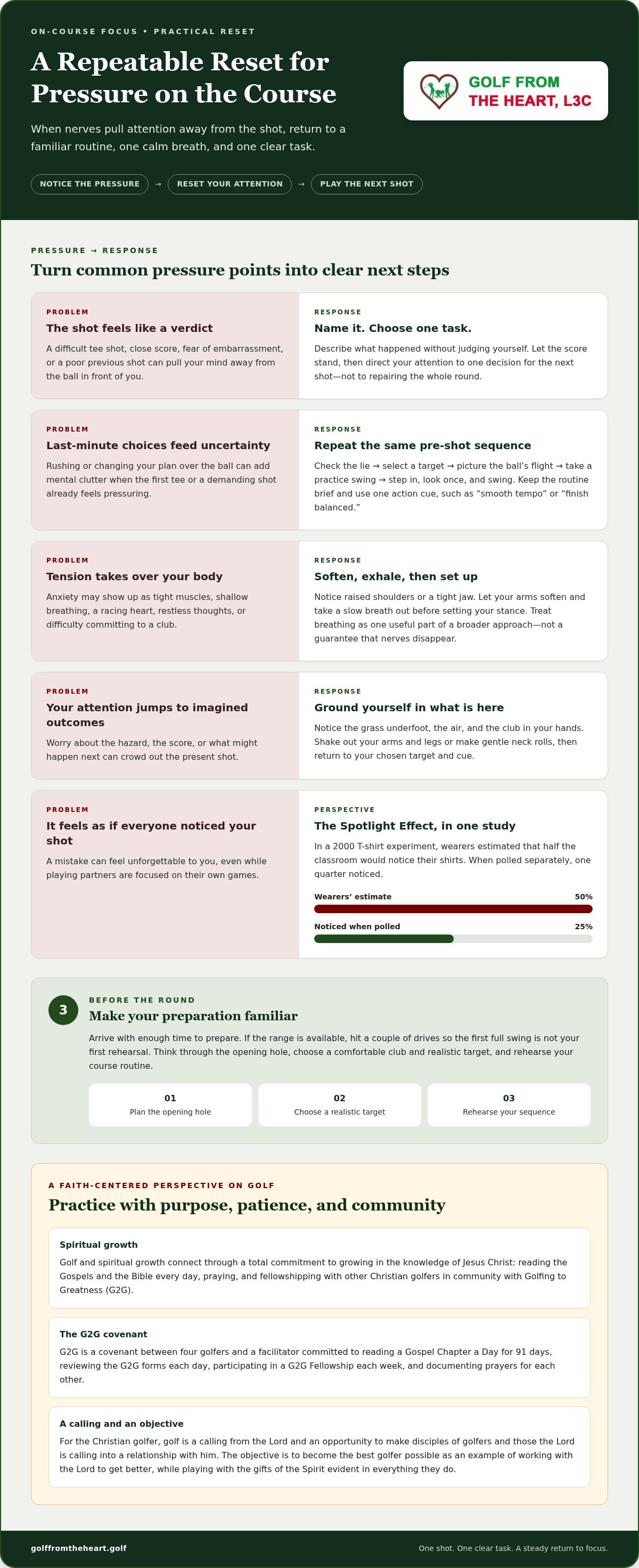
Feeling watched can intensify that pressure. Researchers led by Thomas Gilovich coined the term “Spotlight Effect” in 2000 to describe how people overestimate how much others notice them. In the Barry Manilow T-shirt experiment, wearers estimated that 50% of the classroom would notice their shirts, but 25% noticed them when polled separately. On a golf course, a topped shot can feel unforgettable to you while playing partners are already thinking about their own next swings.
Embarrassment and poor shots are part of learning to play, not proof that you don’t belong on the course. Consider Nikki, who faced a 10-foot putt on the 18th hole while her rival had trailed by one stroke since the middle of the round. After Nikki missed, her rival shot 1-over on the final hole, and Nikki needed four more putts. The example illustrates how pressure can gather around one moment. It also offers a useful reset: accept the mistake, let the score stand, and make the next decision without trying to repair the whole round at once.
If you’re wondering how to overcome golf anxiety, start by noticing when nerves recur, what triggers them, and whether they interfere with your play or enjoyment. A sports psychologist may help when anxiety persists across rounds or makes it difficult to use skills you’ve practised. Alcohol can affect judgment and coordination, while medication may involve effects or interactions that require professional guidance. Don’t use either as a self-directed shortcut for managing nerves. Focus instead on a response you can practise and repeat.
2. Pre-shot routines
A consistent pre-shot routine gives your mind a familiar sequence to follow before each swing. It won’t make every shot easy, but it can reduce last-minute decisions that feed uncertainty. Choose a simple pattern, such as checking the lie, selecting a target, taking a practice swing, then stepping in to play. Repeating those steps helps keep your preparation steady when the first tee feels demanding.
To manage first-tee nerves and performance pressure, arrive with enough time to prepare and use the same routine you’ll follow during the round. If the range is available, hit a couple of drives before teeing off so the first full swing isn’t your first rehearsal. On the tee, choose a club you’re comfortable with, pick a specific target, and follow your steps instead of waiting for confidence to appear.
Keep your routine brief enough to repeat without rushing. For example, stand behind the ball, identify a small target, picture the ball’s flight, and take a practice swing. Step into position, look once toward the target, then swing. A single swing thought can limit mental clutter, such as “smooth tempo” or “finish balanced.” Choose a cue that guides your action rather than judging your ability.
Preparation can begin before you reach the tee. Spend a few minutes noticing the grass underfoot, the air, and the club in your hands. This grounding practice brings your attention to the present, rather than imagined outcomes. Before each shot, you can also shake out your arms and legs or make gentle neck rolls. These actions help you notice and release physical tension before setting up.
Practice and course preparation can reduce anxiety by making decisions more familiar. Before playing, think through the opening hole: its shape, a comfortable club, and a realistic target. At the range, rehearse the sequence you’ll use on the course, including choosing a target and completing your swing. Familiar steps give you something concrete to do when nerves rise, rather than adding new instructions over the ball.
If the first shot doesn’t go as planned, treat it as one shot, not a verdict on the round. Keep your next routine intact: assess the lie, choose a target, and commit to your cue. You can also agree with your group on a breakfast ball before play, allowing a second drive without penalty if nerves affect the first. Agreeing in advance removes uncertainty about what happens next.
Families supporting young players can connect encouragement with skill-building through a community for parents of junior golfers. At home or on the practice ground, help the player rehearse one manageable routine, then praise steady preparation rather than only the result. That keeps practice focused on choices the golfer can repeat on the course.
3. Relaxation and breathing
Breathing gives you a simple action to return to when tension rises during a round. Before a putt, notice whether your shoulders are raised or your jaw is tight. Let your arms soften, then take a slow breath out before setting your stance. That longer exhale can release some immediate tension and give your attention a clear task. Keep it comfortable, not forced.
Slow, deep breathing may help calm nerves in the moment, such as before a demanding tee shot, but it may not be an effective long-term fix for performance anxiety on its own. Treat it as one tool for playing through a pressured moment, not a promise that nerves will disappear. If your breathing feels rushed, pause before approaching the ball and focus on a steady, unforced exhale.
Box breathing gives you a repeatable pattern: inhale for 4 counts, hold for 4, exhale for 4, then hold again for 4. Try one cycle while waiting to play, away from the ball. Keep the counts even and comfortable. If holding your breath feels distracting, return to natural breathing rather than forcing the pattern. The goal is a deliberate reset, not perfect counting.
Use breathing at a practical point in your routine. For example, after choosing a club and target, step behind the ball and fully exhale. Then take your normal stance and begin the swing without adding extra breaths or changing your mechanics. Linking the breath to preparation lets you use the same cue on the range and course.
During practice, compare a relaxed swing with a tense one. Notice what changes in your grip, shoulders, and breathing before each shot. Then rehearse a slow exhale before another swing and observe whether it helps you settle into your familiar motion. The aim isn’t to judge the result, but to learn which breathing cue helps you stay present.
On the course, keep the method simple. If a missed shot leaves you tense, move away from the ball, let your arms hang, and take one unforced exhale. Then return to your next decision. If you use box breathing, complete the 4-count pattern while waiting, not while standing over the ball. A short reset can make room for attention to shift back to playing.
For a lasting approach to how to overcome golf anxiety, pair these in-the-moment breathing tools with practice and reflection. After the round, note which situation raised tension and which breathing cue you used. A simple record, such as “tight grip on the first tee, slow exhale before the next shot,” can help you spot patterns and prepare more intentionally next time.
4. Accepting anxious thoughts without self-criticism
Expect nerves to appear during a round instead of waiting to feel perfectly calm. Before a difficult tee shot, you might think, “I’m going to miss again.” Notice that thought as anxiety speaking, not a prediction you must obey. Trying to force fear away can add tension; acknowledging it leaves room to choose your next action.
Try this brief reset after a poor shot: name the feeling, describe the thought, then return to a task. For example, tell yourself, “I feel embarrassed, and I’m thinking about my group’s reaction.” Then look at the lie and decide what shot you want to play. This won’t erase the mistake, but it can keep one moment from controlling your next decision.
Golf-specific mindfulness can start with what you sense right now. Notice the ground under your shoes, the club’s weight, and the direction of the wind before addressing the ball. For visualization, picture a familiar swing from setup through contact, and the ball’s flight toward your chosen target. Treat the image as rehearsal, not a guarantee of the result.
Self-criticism can turn a single miss into a broad judgment: “I can’t putt,” after one short putt slips past. Replace that verdict with a factual description, such as “That putt finished left.” Then identify what comes next, whether that’s marking the ball or preparing for your following shot. This keeps the lesson specific and prevents blame from taking over your attention.
Embarrassing moments are an inevitable part of learning golf. A topped drive in front of playing partners may sting, but it can also show where practice is needed. Let yourself feel the discomfort without replaying the scene throughout the round. Afterward, consider what you learned and what you’ll practise, then forgive yourself for a human mistake.
Acceptance isn’t approval of every shot, and it doesn’t mean giving up on improvement. It means allowing anxious thoughts without scolding yourself for having them. If “Everyone noticed that miss” comes to mind again, respond, “I’m having that worry,” then bring your attention back to your next choice. Practised this way, self-kindness supports honest reflection and continued effort.
To build the habit, write a short note after playing: the situation, the thought, and your response. For example, record “missed approach, feared judgment, chose a safe next shot.” Review your notes before the next round to recognize recurring triggers. A thoughtful record turns difficult moments into useful information without letting one poor result define your ability.
5. Overestimating how much other golfers notice
A poor shot can feel like a public announcement, especially when your group is nearby. That feeling can shift your attention from the ball to imagined judgments. After topping a drive, for example, you might assume everyone is replaying the miss. Yet a playing partner may already be planning their own approach shot. Notice the difference between what happened and what you’re guessing others think.
The Spotlight Effect helps explain the gap between feeling observed and knowing you’re being watched. In golf, a small mistake can seem unusually visible because you experienced it firsthand. Separate observable details from assumptions: “My ball stopped short” is something you know. “The group thinks I’m a bad golfer” is an interpretation, not a fact.
Try a quick perspective check after an awkward shot. Ask yourself what you remember about your playing partners’ recent swings. If you can recall only a detail or two, they may also be focused mainly on their own games. Then name one task you control, such as choosing a safe target or reading the next putt, and direct your attention there.
Other golfers may notice a shot briefly, but noticing isn’t the same as judging. Someone might watch your ball as they follow play, then turn to their own shot. If a partner comments, respond simply and move on. You don’t need to defend your ability or make a joke to manage the moment. A calm next decision keeps the round moving.
Use a practical reset when self-conscious thoughts return. First, identify the thought: “They’re watching me.” Next, label it as a worry, not evidence. Then look at a real course detail, such as the lie or the distance to your target. Finish by making one clear decision. This sequence shifts attention from imagined reactions back to the game.
You can practise this perspective between rounds, too. At the range, hit a challenging shot, then notice how quickly your attention returns to your next ball. During a casual round, observe how often you think about another golfer’s mistakes. This exercise can make it easier to see that everyone has their own concerns, even within the same group.
For a junior golfer who feels watched, steady encouragement can help turn uncomfortable moments into learning experiences. Families can join the Parents of Junior Golfers 12 - 18 Community to support a young player’s growth in golf and confidence. After a round, ask which moment felt most exposed and what the golfer wants to try next time.
GolfFromtheHeart.golf: Golf From the Heart Evaluation and Golf Lessons
GolfFromtheHeart.golf offers Golf From the Heart Evaluation and Golf Lessons for golfers seeking guidance as they develop their skills and approach to play. Spiritual growth calls for total commitment to knowing Jesus Christ through daily reading of the Gospels and the Bible, prayer, and fellowship with other Christian golfers in Golfing to Greatness (G2G).
G2G is a covenant between four golfers and a facilitator: they read a Gospel Chapter a Day for 91 days, review G2G forms each day, join a G2G Fellowship each week, and document prayers for one another. For Christian golfers, golf is a calling from the Lord and an opportunity to make disciples of golfers and those the Lord is calling into a relationship with Him. The aim is to become the best golfer possible, work with the Lord to improve, and show the gifts of the Spirit in all you do.
Visit golffromtheheart.golf to learn more.
Carry a calmer mindset into your next round
Your next round is a chance to practise responding with intention, not a test of whether you can avoid every mistake. Choose one process goal before you play, such as staying committed to your decisions or showing patience with yourself and your playing partners. Afterward, reflect on one moment when you acted according to that intention. This shifts progress beyond the score alone, toward the golfer and person you’re becoming.
A practical approach to how to overcome golf anxiety can also make room for a deeper purpose. For Christian golfers, the course can be a place to grow in faith, encourage others, and use their gifts with care. If guided instruction or a community would help you keep growing, explore Golfing to Greatness Local & Online, alongside the available golf lessons and evaluation.
Visit GolfFromtheHeart.golf to take a thoughtful next step. Keep showing up, keep learning, and let each round be an opportunity to grow.
Frequently Asked Questions
How Does Anxiety Affect Golf Performance?
Anxiety can disrupt a golfer’s ability to choose and execute a shot with their usual rhythm. For example, a player may change clubs repeatedly after reaching the ball, then rush the swing to make up for lost time. That divided attention can make a familiar decision feel uncertain. In Panama City Beach, notice whether pressure changes your choices or pace, not just whether the ball reaches the target.
What are quick breathing techniques to calm nerves on the golf course?
While waiting for your turn, try one comfortable, complete exhale, then let your next breath arrive naturally. Keep this reset separate from the swing so you don’t add a new movement to manage at address. For example, after leaving the cart or walking to your ball, pause, exhale, and look at the lie. If focusing on breath feels uncomfortable, return to normal breathing and attend to your next practical decision.
How can golfers build a pre-shot routine to reduce anxiety?
Build a routine from actions you can repeat comfortably, then test it in practice before relying on it during a round. Rehearse your sequence on different lies at the range, for example, and notice which steps remain useful without slowing you down. Keep the routine focused on preparation, not controlling the outcome. If a step adds pressure, simplify it and practise the revised sequence until it feels familiar.
Can golf anxiety be related to choking, perfectionism, or fear of embarrassment?
Yes. These pressures can overlap: a golfer expecting a perfect shot may treat a miss as public proof of failure, then tense up on the next attempt. Choking describes performance becoming disrupted under pressure, while embarrassment can turn attention toward imagined judgment. Identify the strongest concern in that moment. This helps you choose a response, such as setting a realistic process goal instead of demanding a flawless result.
What are the risks of using alcohol or medication to manage golf anxiety?
Alcohol can affect judgment and coordination. Medication may have effects or interactions that require professional guidance, so neither should be used as a self-directed shortcut for managing nerves.


