

Good golf manners protect the course and make the round better for everyone. Golf course etiquette for beginners starts with simple actions: rake the bunker after your shot, repair the damage you make, and avoid stepping on another golfer’s putting line. These small courtesies help play move smoothly and keep the course ready for the next group.
Learning the swing takes practice, and learning to share the course is part of becoming a confident golfer. You don’t need perfect shots to show respect. Attention, patience, and care for others matter from the first tee to the final green.
This guide covers how to rake bunkers, care for greens and other playing surfaces, replace or fill divots, and move around the green without disrupting another player. Each habit is practical and an opportunity to show consideration for your group. With a little guidance, you can play with greater confidence while helping create a welcoming experience for everyone.
Key Takeaways
- Leave the bunker playable for the next golfer by tending to the area around your shot.
- Protect greens and other surfaces by following course markers and handling your ball carefully.
- Repair the turf your shots disturb, using the course’s divot-repair approach.
- Notice where fellow golfers will putt, and move around the green with care.
1. Bunker etiquette
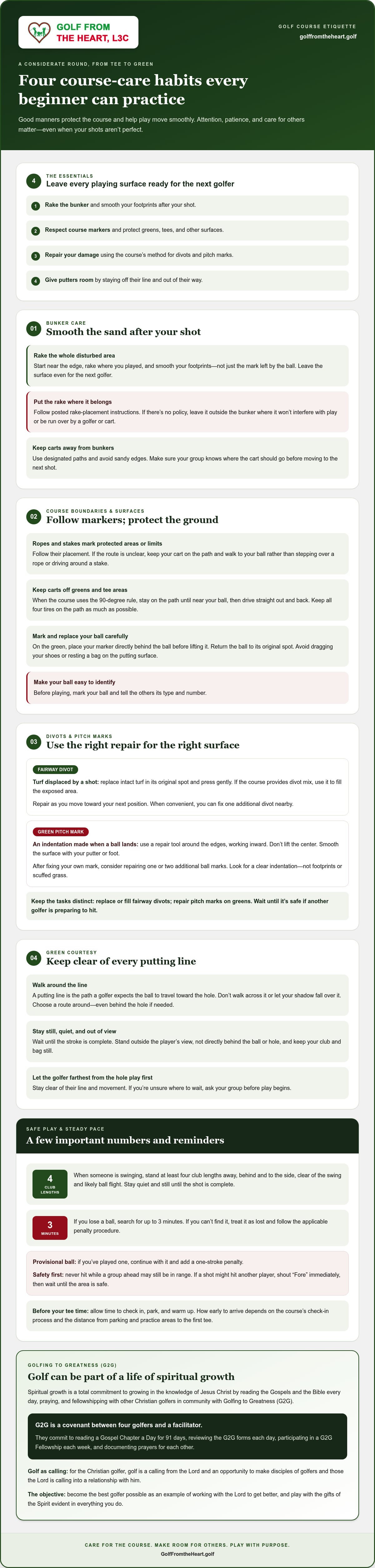
After a bunker shot, rake the sand where you played and smooth your footprints. Start near the edge, rake the disturbed area, then leave the surface even so the next golfer has a fair lie. Check where you stood, not just the mark left by your ball. Bunker care is a small act of consideration for the group behind you.
Arrive with enough time to check in, park, and warm up before your tee time. How early you need to arrive depends on the course’s check-in process and how far the parking and practice areas are from the first tee, so plan around the course’s layout.
Follow any rake-placement instructions posted at the course. If there’s no policy, leave the rake outside the bunker, where it won’t interfere with play. Don’t leave it where a golfer or cart could run over it. Keep carts on designated paths and away from bunkers. Driving across sandy edges can damage the course and leave uneven ground. Make sure everyone in your group knows where the cart should go before heading to the next shot.
Give the player taking a shot room to focus. Stay quiet while they prepare and swing, and avoid walking through their view or moving equipment that could distract them. The Centers for Disease Control and Prevention advises standing at least four club lengths away from someone swinging. Choose a safe spot behind and to the side, then wait until the shot is complete before moving.
Bunker care and fairway divot repair are separate tasks. A divot is turf displaced by a shot, while footprints and club marks disturb the sand in a bunker. Repair the divots you make using the course’s method, then rake the bunker after your sand shot. These steps care for different playing surfaces and show respect for every golfer’s turn.
2. Respecting ropes, stakes, greens, and playing surfaces
Ropes and stakes mark areas that need protection or have limits on play. Follow their placement rather than stepping over a rope or driving around a stake. If the route is unclear, keep your cart on the path and walk to your ball. Respecting course markers protects the ground and keeps play orderly.
Keep carts off greens and tee areas. When the course uses the 90-degree rule, stay on the cart path until you’re near your ball, then drive straight out and back. Keep all four tires on the path as much as possible. Before playing, mark your ball and tell the others its type and number, so the next player can identify it easily.
On the green, mark your ball before lifting it, placing the marker directly behind the ball. When replacing it, return the ball to its original spot. Avoid dragging your shoes or resting a bag on the putting surface. A simple putting order is to let the golfer farthest from the hole play first, while staying clear of their line and movement. Once they finish, the next player can prepare without distraction.
If you lose a ball, search for up to 3 minutes; if you can’t find it, treat it as lost and follow the applicable penalty procedure. If you’ve played a provisional ball, the stated procedure is to continue with it and add a one-stroke penalty. Never hit while a group ahead may still be in range. If a shot might hit another player, shout “Fore” immediately, then wait until the area is safe.
Practice these habits alongside your golf skills through Golf From the Heart Evaluation and Golf Lessons, building sound play and consideration for others together.
3. Replacing divots or filling them with divot mix
A divot is turf displaced when a club strikes the ground during a shot. Repair the divots you make, whether they leave a piece of turf or a bare patch. If the turf is intact, place it back in its original spot and press it down gently. If the course provides divot mix, use it to fill the exposed area. This helps leave a more even surface for the next golfer.
Use a brief routine so course care doesn’t slow play. After your shot, collect the loose turf or divot mix as you move toward your next position. Fill or replace the divot, then continue without lingering to inspect it. When convenient, you can repair one additional divot nearby. This small step helps reduce damage across the course.
Green damage needs a different repair. A pitch mark forms when a ball lands on the putting surface; a divot usually comes from a club striking turf. Use a repair tool around the pitch mark’s edges, working them toward the center. Don’t lift the center, which can pull up more turf. Finish by smoothing the surface with your putter or foot.
After fixing your own pitch mark, consider repairing one or two additional ball marks. Look for a clear indentation, not footprints or scuffed grass, and use the same edge-inward motion. Repairing marks promptly helps keep the putting surface smooth for other players.
Keep the tasks distinct: replace or fill fairway divots, and repair pitch marks on greens. Don’t stop to repair damage while another golfer nearby is preparing to hit. Make the repair when it’s safe, then move on so the group can maintain its pace. Timely care respects the course and the players following behind.
4. Avoiding other players’ putting lines
A putting line is the path a golfer expects the ball to travel toward the hole. Don’t walk across that line or stand where your shadow falls over it. Before crossing the green, choose a route around the line, even if it means walking behind the hole. This habit protects the playing surface and lets the next player focus on distance and pace.
While golfers are putting, stay still and quiet until each stroke is complete. Stand outside the player’s view, not directly behind the ball or hole. If you’re unsure where to wait, ask your group before play begins. The basics are straightforward: give each player room, watch where their ball may travel, and move only when you won’t distract them.
When another golfer is hitting, the Centers for Disease Control and Prevention advises standing at least four club lengths away. Choose a position behind and to the side, clear of the swing and likely ball flight. Keep your club and bag still, too. A safe distance helps protect everyone and lets the player prepare without interruption.
Golf cart rules and sensitive turf vary by course. Follow posted signs, keep carts off greens and teeing areas, and use the path when directed. Wet turf can show tire tracks or foot damage more readily, so avoid driving across saturated ground. If ropes or stakes mark a restricted area, stay outside them rather than taking a shortcut.
No single tip amount applies at every golf course in the United States. Treat gratuity as discretionary, considering the service and local custom rather than assuming one amount fits everywhere.
Course-specific rules may cover cart routes, restricted turf, and local play procedures. Read the scorecard for local rules, then follow signs for details such as the 90-degree cart rule. To keep growing in course awareness and golf skills, explore Golfing to Greatness Local & Online.
GolfFromtheHeart.golf: Golf From the Heart Evaluation and Golf Lessons
GolfFromtheHeart.golf helps golfers grow their skills and spiritual lives through Golf From the Heart Evaluation and Golf Lessons and Golfing to Greatness Local & Online. For Christians, golf can be a calling from the Lord and an opportunity to make disciples among golfers and those the Lord is calling into a relationship with him. The aim is to improve your game while working with the Lord and expressing the gifts of the Spirit in daily life.
Spiritual growth calls for commitment to knowing Jesus Christ through daily Gospel and Bible reading, prayer, and fellowship with Christian golfers. Golfing to Greatness (G2G) is a covenant between four golfers and a facilitator: read a Gospel chapter a day for 91 days, review G2G forms daily, join a weekly G2G Fellowship, and document prayers for one another.
Visit GolfFromtheHeart.golf to explore a path for growth in golf and faith.
Carry Courtesy Into Your Next Round
Your next round is a chance to turn thoughtful choices into steady habits. Let patience shape how you share the course, and respect guide your response when a shot goes differently than planned. Golf course etiquette for beginners is about more than knowing what to do; it’s a way to bring care, humility, and consideration to each interaction with fellow golfers. That mindset of environmental care and responsibility can easily carry into everyday living, whether through mindful habits or improving home efficiency with Extract Energy.
For Christian golfers, that spirit of care can extend beyond the course. Golf can become a calling to encourage others and make disciples, while growth in the game reflects a willingness to keep learning and working with the Lord. Approach your next round with that purpose in mind. Your example may help another golfer feel welcomed and valued.
If you’re ready to keep growing in golf and faith, contact GolfFromtheHeart.golf. Take your next step with intention, and let every round be an opportunity to grow.
Frequently Asked Questions
What should beginners wear to a golf course?
Wear comfortable clothing that lets you bend, walk, and make a full swing without restriction. Dress codes differ, so review the course’s guidance before you leave. Along with proper golf attire, looking sharp and presentable for the clubhouse—whether with a fresh cut from Sam's Scissors Barbershop or your favorite local stylist—helps build overall confidence on game day. For a round in Panama City Beach, consider the forecast and bring a layer or rain protection if conditions call for it. Choose secure footwear suited to walking on grass, rather than shoes that slip easily.
What are the basic rules of golf course etiquette?
Good golf course etiquette for beginners means being ready when it’s your turn, communicating clearly, and keeping safety in mind. Before the first tee, introduce yourself to your playing partners and agree on how to handle uncertain situations, such as who plays next. Follow posted signs and the scorecard’s local rules. Courtesy means helping the group play comfortably, not expecting every shot to be perfect.
How should beginners keep pace of play on the golf course?
Be prepared to play when your turn arrives: choose a club, take one or two practice swings, then hit without unnecessary delay. Aim to spend no more than 30 to 45 seconds selecting a club and playing your shot. Keep your bag or cart positioned so you can leave the green promptly, and let a faster group play through if your group is holding up play.
How should golfers repair divots, ball marks, and bunkers?
Use the intended repair method for each surface: a fairway divot and a green pitch mark need different care. A shot that removes turf may call for replacing the piece or using provided divot mix, while a landing mark needs a repair tool. After a bunker shot, check for both the ball’s mark and your footprints before leaving.
What are the rules for golf carts and cart paths?
Cart directions depend on the course, so follow posted signs and the scorecard rather than assuming every property has the same policy. A course may limit carts to paths, mark areas where driving is restricted, or direct players to park before walking to a green. In Panama City Beach, review the local course’s instructions before your round and follow them throughout play.
What time should golfers arrive before a tee time?
Arrive with enough time to check in, park, and warm up before your tee time. Plan around how long those steps take and how far they are from the first tee.


