

Consistency starts before the club moves. Learning how to build a consistent golf swing begins with a repeatable setup and continues through balanced rotation, solid impact, and a controlled finish. Video feedback can help you see whether those parts work together from swing to swing.
It’s easy to focus on a shot that went wrong, but lasting progress comes from noticing the movement behind the result. A clear video view can help you spot patterns, choose one adjustment, and practise it patiently instead of changing everything at once.
This guide covers setup, takeaway, impact, and follow-through, then explains how to record and review your swing from useful angles. You’ll learn what to observe and how to turn those observations into a steady practice routine. Golf can also support growth in faith and character: careful practice develops patience and humility, while shared rounds can create space for encouragement and fellowship.
Key Takeaways
- Build a repeatable setup by checking your grip, posture, alignment, and ball position before each swing.
- At impact, notice how your hands and the clubface relate to the ball to better understand your strike.
- Use a balanced finish to assess whether your rotation and hand position stay controlled through the swing.
- Record your motion from useful angles, then review one pattern at a time so your practice has a clear focus.
Balance, rotation, and hand position in the follow-through
- Finish each practice swing in balance, with both feet grounded and most of your weight on your lead foot. Hold the position for a moment rather than stepping away. If you stumble or need to reset your feet, treat that as useful feedback: your finish can reveal whether your movement stayed controlled through impact.
- Use your rotation as a reference, not a position to force. At the top of the backswing, the suggested movement is a 90-degree shoulder turn and roughly 45-degree hip rotation. The suggested weight distribution there is 25/75 between the front and trail foot. From that position, rotate toward the target and let the finish develop without stopping abruptly.
- Track your hands through the finish. After contact, let your arms continue moving as your chest turns toward the target. Notice where your hands settle and whether they reach the finish smoothly. Compare several swings to see whether your hands finish in a similar place, rather than forcing a pose with your wrists.
- Practise the finish with a rehearsal drill. Make a slow swing without a ball, rotate through, and hold your balanced position. Then hit a ball and repeat the same motion. Alternate shots with rehearsals so the drill teaches your body the movement. Focus on one cue, such as “turn through and hold,” rather than juggling several mechanical thoughts.
- Use a 100-ball practice session with a deliberate split when learning a technical change: devote 75 balls to technique and 25 balls to routines. For the technique portion, repeat your finish drill between shots and observe balance, rotation, and hand position. On the course, keep the routine simple; you have about 1.5 seconds to perform the swing, so rehearse the feeling once, focus on the target, and play.
Forward shaft lean and clubface position at impact
- Follow the swing in sequence: takeaway, backswing, downswing, impact, then follow-through. Let each phase flow into the next instead of stopping to force a position. This gives you a simple framework for noticing where the clubface or contact starts to vary.
- Start the takeaway with your arms, shoulders, and hands moving together. When the club is parallel to the ground, check that its face remains square to the target. Use a smooth, steady tempo. Snatching the club away can separate your hands from your turn and make the clubface harder to manage.
- Build the backswing from that connected start, then change direction into the downswing without rushing your hands. Aim for continuous motion, not a pause followed by a sudden effort. Rehearse the transition slowly, then repeat it at a comfortable pace while focusing on one cue.
- At impact, position your hands slightly ahead of the ball to encourage a downward strike. This forward shaft lean should come from moving through the ball, not from forcing your wrists into a fixed position. Practise with a short swing and notice whether the club contacts the ball before the ground.
- Common causes of inconsistent contact, slices, or hooks include a clubface that arrives open or closed, a rushed transition, and arms that separate from the body’s movement. Compare a shot that curves right with one that curves left, then review the clubface and hand position around impact. Change one thing at a time so each practice swing tests a clear adjustment.
Grip, alignment, posture, and ball position at setup
- Set your grip before taking your stance. Place both hands comfortably on the handle, then check that they work together rather than fighting for control. Keep your hold steady as you address the ball. If the club twists during your takeaway, pause and reset your hands instead of compensating mid-swing.
- Build a balanced posture around the ball. Stand close enough to reach the handle without stretching, and let your arms hang naturally. Choose a comfortable posture that allows your shoulders and arms to move freely. Before swinging, check that you can make a small rehearsal without losing balance or reaching farther toward the ball.
- Align your body to the target line. Choose a specific target, then position your feet, hips, and shoulders parallel left of that line. Pick an intermediate spot on the ground, such as a leaf between you and the target, to help with alignment. Look toward the target and picture the ball travelling toward it before you swing.
- Adjust the ball’s distance for the club. Position the ball farther from yourself when using a longer club. For example, a driver setup may place the ball farther from your body than an iron setup. Recheck your reach when you change clubs; don’t automatically keep the same distance if the club length changes.
- Use a repeatable setup for irons and driver. With either club, check your grip, posture, and alignment in the same order, then adjust the ball distance to suit the club length. This creates a consistent starting routine without forcing identical positions for different clubs. Before each shot, confirm your target and picture the ball moving toward it.
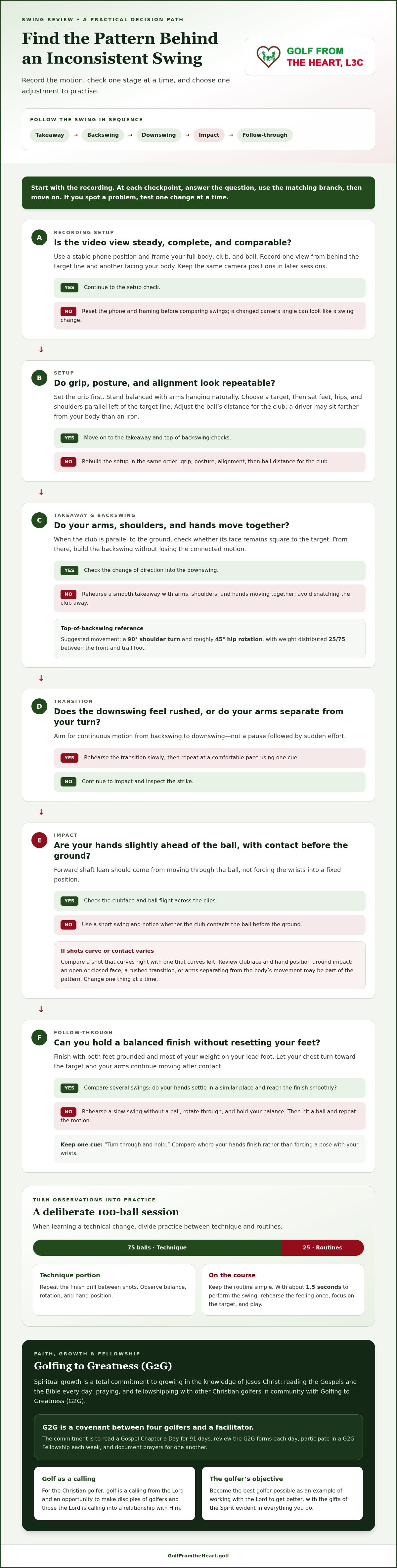
Recording and evaluating a golf swing
- Keep the camera view consistent. Place your phone on a stable surface and frame your full body, club, and ball. Record one view from behind the target line and another facing your body. Use the same positions in later sessions so you can compare movements fairly, rather than mistaking a changed camera angle for a swing change.
- Review key moments, not every detail. Pause at setup, the top of the backswing, impact, and finish. Check whether your alignment and posture stay steady, then notice how the club approaches the ball. Compare the finish across clips. Write down one clear pattern, such as your balance shifting or your arms separating from your turn.
- Choose one drill and connect it to a filmed swing. Rehearse a slow backswing, pause briefly at the top, then swing through to a balanced finish. Record the rehearsal and a normal shot from the same view. Compare the motions, then alternate rehearsals with shots so the drill has a clear purpose.
- Practise on a repeatable schedule. Return to the same swing cue in regular sessions, keeping each one focused enough to observe that cue clearly. Choose a frequency you can sustain while maintaining attention and sound movement. If fatigue changes your tempo or balance, pause rather than rehearsing a tired motion. Supporting your stamina also comes from overall fitness, where platforms like Hero AI can make tracking daily nutrition and macros effortless to sustain high energy levels.
- Prepare your body with gradual movement. Before hitting balls, try gentle torso rotations, arm circles, hip hinges, and easy practice swings. Gradually increase the range and pace, then begin with controlled swings before fuller shots. These movements prepare your shoulders, trunk, and hips for golf motion and help you notice stiffness before practice.
If you want guidance interpreting your swing footage and choosing a focused adjustment, explore Golf From the Heart Evaluation and Golf Lessons.
GolfFromtheHeart.golf: Golf From the Heart Evaluation and Golf Lessons
GolfFromtheHeart.golf offers Golf From the Heart Evaluation and Golf Lessons for golfers seeking thoughtful feedback and purposeful instruction. Consider an evaluation when swing footage leaves you unsure what to practise next, or lessons to connect mechanics with steady improvement.
For Christian golfers, golf is a calling from the Lord and an opportunity to make disciples. Becoming the best golfer possible can demonstrate working with the Lord to improve, while showing the gifts of the Spirit in daily life. Spiritual growth means committing to know Jesus Christ through daily Gospel and Bible reading, prayer, and fellowship with Christian golfers through Golfing to Greatness (G2G).
G2G is a covenant between four golfers and a facilitator: read a Gospel Chapter a Day for 91 days, review G2G forms each day, join a G2G Fellowship each week, and document prayers for one another.
Visit golffromtheheart.golf to explore your next step.
Carry Your Practice Forward
Choose one intention for your next practice: move with patience, stay present through the shot, or respond to mistakes with calm attention. A clear intention can give your work meaning beyond the scorecard and help you bring the same steadiness to the people around you.
As you learn how to build a consistent golf swing, remember that improvement is an ongoing practice, not a single breakthrough. Let each session teach you something, then give yourself time to apply it. The discipline you bring to golf can also shape how you listen, encourage others, and serve with care.
If you’re ready for guidance with your next step, contact GolfFromtheHeart.golf for swing help.
Keep showing up with purpose. Much like mastering any hands-on technical discipline—whether working through vehicle maintenance guides from Ellery Books or fine-tuning a golf swing—steady effort and patience strengthen both your game and the way you share it with others.
Frequently Asked Questions
What are the fundamentals of a consistent golf swing?
A practical starting point for how to build a consistent golf swing is to repeat the same pre-shot routine and assess patterns across practice sessions. Note your intended shot and its result, then decide whether a recurring miss deserves focused attention. This helps distinguish a lasting tendency from one poor strike and gives each practice session a clear purpose.
What golf grip, stance, posture, and alignment should beginners use?
Beginners should use a grip that feels secure without requiring a tight squeeze, then establish a balanced stance that lets the arms hang naturally. Rather than copying a professional’s setup, ask a teaching professional to observe your stance with a familiar club. Make one adjustment at a time, then notice whether it helps you address the ball comfortably and repeat your routine.
How can golfers improve swing tempo and balance?
Practise making the whole motion feel continuous instead of trying to speed up the club with your hands. One useful exercise is to swing slowly without a ball, then make another swing at a comfortable playing pace. Notice whether the second motion keeps the same sense of rhythm. If your balance changes as you add speed, return to the slower rehearsal.
How can golfers use video or launch monitors to analyze swing consistency?
Use video to compare how your motion changes between shots, and a launch monitor to review the shot information it provides. For a fair comparison, record the same club and type of intended shot rather than mixing different situations. Look for a repeated relationship between movement and outcome, then choose one adjustment to test in a later practice session.
Should you take golf lessons or use online swing instruction, and what do lessons cost in the United States?
Lessons provide direct feedback, while online instruction lets golfers review guidance independently. Choose based on how you learn and practise best. Golf lesson costs in the United States vary with the instructor, lesson format, session length, and location. Compare what instruction covers and whether it addresses your current learning goal, rather than choosing by price alone.


